


This article examines the idea of AI as a mirror, asking how AI may be reshaping body image, identity, and self-concept and how clients can reclaim a broader sense of self.
Related articles: When Machines Become Conversation Partners, Ethical Use of Artificial Intelligence in Mental Health Care.
Jump to section
Introduction
“I know the pictures aren’t real.” Sophie stared at the floor for a long moment before continuing. “That’s the strange part. I know they’re AI-generated. I know nobody actually looks like that. But after I spend half an hour scrolling through them, I look in the mirror and all I can see is what’s wrong with me.”
Her therapist resisted the understandable temptation to reassure her. Instead, she asked quietly, “What happens inside you in the moments after you look?”
Sophie was silent for several seconds. “I feel…” she began, searching for the words. “Ashamed.”
For many therapists, conversations like this are becoming increasingly familiar. Clients describe spending hours viewing idealised images online, experimenting with AI image generators, editing photographs of themselves, or comparing their appearance with faces and bodies that, quite literally, have never existed. Some present with ordinary appearance dissatisfaction.
Others struggle with body dysmorphic concerns, disordered eating, compulsive comparison, or profound shame. For a smaller but deeply vulnerable group, relentless self-criticism may coexist with self-harm or thoughts of suicide.
In these moments, therapists are not primarily wondering how artificial intelligence works. They are wondering something far more immediate: How do I help this person sitting in front of me?
That is where this second article of our Living Well in an AI World series begins (read the first article here). Not with algorithms. Not with technology. But with human suffering. Yet, if we remain only at the level of the body, we may overlook something equally important.
Appearance concerns as a language for deeper fears and hopes
Human beings rarely compare appearances in isolation. More often, appearance becomes a language through which deeper fears and hopes are expressed: fears about belonging, being valued, being lovable, being successful, or somehow being “enough.” The body becomes the visible surface upon which much older stories about identity are written.
Artificial intelligence did not invent these stories. Long before the first image generator appeared, people were comparing themselves with cultural ideals, questioning their worth, and searching for reflections that might reassure them they were acceptable. What AI has changed is the nature of the mirror itself. Instead of reflecting ordinary human variation, it can now produce an endless stream of flawlessly optimised faces and bodies – images unconstrained by biology, ageing, fatigue, or even reality. For many people, comparison has become not simply more frequent, but potentially limitless.
The twofold challenge for therapists
The challenge for therapists, therefore, is twofold. First, they must respond compassionately and skilfully to the client’s immediate distress, recognising when body image concerns may signal more serious presentations requiring specialist assessment or intervention. At the same time, they have an opportunity to help clients explore a broader question: What standards have these images taught me to use when judging myself?
As we shall see, that question ultimately extends far beyond appearance. The same processes that shape how people evaluate their bodies can gradually influence how they evaluate their intelligence, productivity, relationships, ageing, creativity, and even their right to feel content with an ordinary human life.
Seen in this light, AI-generated images are not simply changing what people look at. They may also be changing the mirrors through which people come to know themselves.
Looking into the AI Mirror
Human beings have always looked for reflections of themselves. Sometimes those reflections have been literal, found in still water, polished metal, or a bathroom mirror. Far more often, however, they have been psychological. We discover something about ourselves through the responses of other people: a parent’s smile, a friend’s encouragement, a teacher’s criticism, a partner’s admiration, or a stranger’s glance. Throughout life, these countless moments quietly shape the way we come to understand who we are.
This process is so familiar that it often goes unnoticed. Most people assume they simply “know” themselves. Yet our sense of self is never formed in isolation. It develops gradually through the reflections offered by family, friends, communities, and the wider culture. Every society, whether intentionally or not, communicates messages about what is attractive, successful, admirable, desirable, or worthy of attention. Over time, those messages become part of the lens through which people evaluate themselves (Bowlby, 1990; Cooley, 1902/1964; Siegel, 2020).
A mirror, therefore, does much more than reflect appearance (Winnicott, 1971). It also invites interpretation. A person rarely looks in the mirror and thinks only, “My hair needs brushing”. More often, the mirror becomes the starting point for a much deeper internal conversation:
- Do I look acceptable?
- Do I measure up?
- Will other people find me attractive?
- Am I somehow falling short?
The reflection itself does not answer these questions. Instead, it provides an opportunity for long-held beliefs, hopes, fears, and insecurities to speak.
Comparison with endless perfect, unreal images
For generations, these psychological mirrors were shaped largely by the people and environments surrounding us. Family members, peers, television, magazines, advertising, and social media all contributed to the standards against which people compared themselves. While these influences have never been neutral, they were still constrained by reality. Even highly edited photographs usually began with a real person (Festinger, 1954; Tiggemann & McGill, 2004).
Artificial intelligence introduces something subtly but profoundly different. Rather than simply displaying idealised human beings, AI can generate an endless stream of entirely fictional faces and bodies that appear completely authentic. These images are unconstrained by genetics, ageing, illness, fatigue, or even the limits of human anatomy. They can be endlessly refined, endlessly varied, and endlessly available. As a result, comparison is no longer limited to exceptionally attractive people who actually exist. Increasingly, people find themselves comparing their appearance with individuals who have never lived at all (Fardouly & Vartanian, 2016; Sundar, 2015; Dwivedi et al., 2023).
For therapists, however, the most important question is not whether these images are realistic. It is what happens after a client sees them. Two clients may spend exactly the same amount of time viewing AI-generated images yet experience them very differently. One may simply admire the creativity before moving on with the day. Another may find themselves scrutinising every perceived flaw in the mirror, avoiding social situations, restricting food, compulsively editing photographs, or feeling overwhelmed by shame. The image itself is only one part of the story. Equally important is the meaning that the individual attaches to what they see (Hayes et al., 2012).
This distinction gently shifts the therapist’s attention away from the technology alone and back towards the person sitting in front of them. Rather than asking, “How dangerous are AI-generated images?”, the more clinically useful question becomes, “What has this image come to mean for this particular client?”
That question opens a much richer therapeutic conversation. It encourages curiosity rather than assumption, recognising that the same image may evoke admiration in one person, indifference in another, and profound emotional pain in someone else. It also reminds us that AI-generated images are not creating entirely new psychological processes. Rather, they are entering into processes that have accompanied human development for centuries (Rogers, 1961; Siegel, 2020).
Artificial intelligence has not invented comparison, self-consciousness, or the desire to be accepted. Nor has it replaced the deeply human ways in which people come to understand themselves. It has simply introduced new mirrors through which people come to know themselves.
Self-evaluation: What standards does AI teach clients to use?
Recognising this helps therapists avoid becoming preoccupied with technology itself. The goal is not simply to determine whether clients should spend more or less time engaging with AI-generated images. Instead, the therapist becomes interested in a more fundamental question: What standards are these images teaching this person to use when evaluating themselves?
As we shall see in the next section, answering that question requires us to step back even further, to consider how human beings develop a sense of self long before they ever stand in front of a mirror. Understanding those earliest psychological reflections helps explain why AI-generated images can sometimes exert such a powerful influence – not because they create entirely new vulnerabilities, but because they interact with ways of knowing ourselves that have been forming since the very beginning of life.
How human beings learn who they are
Long before children recognise themselves in a mirror, they begin discovering themselves in the faces of other people. An infant smiles and someone smiles back. A toddler falls and someone comforts them. A young child proudly holds up a drawing and instinctively looks towards a parent, teacher, or caregiver, waiting to see their response. Across thousands of these seemingly ordinary interactions, children gradually begin answering life’s earliest psychological questions: Am I seen? Am I valued? Am I safe? Am I enough? Their understanding of themselves develops not in isolation, but within relationship (Bowlby, 1990; Winnicott, 1971).
This process continues throughout life. Although adults often think of identity as something fixed or internal, our sense of self remains remarkably responsive to the reflections we receive from the world around us. Friends encourage us. Colleagues recognise our strengths. Partners reassure us when we doubt ourselves. Communities communicate what they admire, celebrate, or reject. Even when we believe we are making independent judgments, we are constantly interpreting these social reflections as we refine our understanding of who we are (Cooley, 1902/1964; Siegel, 2020).
Making sense of self through comparison
Psychologists have long recognised that people do not simply evaluate themselves in absolute terms. Instead, they make sense of themselves through comparison. We notice where we seem similar to others, where we appear different, and what those differences might mean about our value or place in the world. In moderation, this process is entirely normal.
Comparison can inspire growth, encourage learning, and help people understand where they belong within their social world. Difficulties arise when the standards against which people compare themselves become increasingly unrealistic, unattainable, or narrowly defined (Festinger, 1954; Fardouly & Vartanian, 2016).
This is where artificial intelligence introduces a subtle but significant shift. Historically, even highly idealised images were still constrained by reality. Fashion models became tired. Athletes aged. Actors had blemishes, illnesses, difficult days, and ordinary human limitations beyond the carefully curated photograph.
Today’s AI-generated images, however, need not be constrained by any of these realities. They can be endlessly refined, endlessly youthful, endlessly symmetrical, and endlessly available. More importantly, they can be generated in unlimited numbers, creating an almost inexhaustible supply of apparently perfect people who have never existed.
The psychological consequence is not simply that people see more beautiful images. It is that they encounter more opportunities to ask difficult questions about themselves.
- “Why don’t I look like that?”
- “Why can’t I be more disciplined?”
- “Why does everyone else seem to have it together except me?”
Over time, these questions can become so familiar that they begin to feel less like passing thoughts and more like established truths.
Comparison of identity beyond body generates overwhelm
Yet there is another subtle shift taking place. When people compare themselves with AI-generated images, they are rarely comparing only appearance. The image often comes to represent something much broader. It may symbolise youth, confidence, popularity, success, happiness, self-control, desirability, or social acceptance. Without consciously realising it, the individual begins comparing not only their body but their entire identity with what the image appears to represent.
This helps explain why body image concerns can become so emotionally overwhelming. The distress is often far greater than dissatisfaction with physical appearance alone. Instead, appearance becomes the visible expression of deeper questions about worth, belonging, adequacy, and identity. The mirror becomes a place where people evaluate not simply how they look, but who they believe themselves to be.
For therapists, this distinction gently broadens the conversation. When a client says, “I hate the way I look,” the therapist need not immediately move away from the body. The body matters, and the distress deserves to be taken seriously. At the same time, curiosity invites another possibility. Rather than assuming the conversation ends with appearance, the therapist might wonder what hopes, fears, or assumptions about the self have quietly attached themselves to that image.
The meaning in the image
Sometimes the most helpful therapeutic question is not, “Is this image realistic?” It is, “What has this image come to mean about you?”
That single question often opens the door to a much deeper understanding of the client’s experience. It allows therapy to honour the reality of body-related distress while gently exploring the wider beliefs that may be sustaining it. Rather than dismissing the mirror, therapy becomes interested in understanding the story the mirror has come to tell.
This perspective also offers hope. If clients have learned to evaluate themselves through particular reflections, they may also learn to recognise, question, and gradually reshape those reflections over time. The goal is not to convince people to ignore mirrors altogether. It is to help them become increasingly thoughtful about which mirrors deserve to influence the way they see themselves.
Bringing the mirror into the therapy room
Understanding how people develop their sense of self helps explain why AI-generated images can have such a powerful emotional impact. The therapist’s next task, however, is not simply to understand the process. It is to help the client who is sitting in front of them today.
For many practitioners, the immediate temptation is to challenge the comparison itself.
- “Those pictures aren’t real.”
- “Most of those images are edited.”
- “You shouldn’t compare yourself.”
Although these responses are well intentioned, they often provide surprisingly little relief. Most clients already know, intellectually, that AI-generated images are unrealistic. Yet knowledge alone rarely changes the emotional experience of shame, inadequacy, or self-disgust. In much the same way that understanding anxiety does not immediately stop someone feeling anxious, recognising that an image is artificial does not necessarily prevent the nervous system from responding to it.
Start with curiosity
A more helpful starting point is curiosity. Rather than attempting to convince clients that they should not feel distressed, therapists can begin by understanding how the image has become psychologically significant for this particular person. Questions such as,
- “What happens inside you after you see these images?”
- “What do you find yourself thinking about afterwards?”
- “What do these images seem to say about the kind of person you should be?”
invite clients to slow down the experience rather than simply react to it. Notice that none of these questions focuses primarily on the image itself. Instead, they explore the meaning the image has acquired.
This distinction often marks an important turning point in therapy. The therapist is no longer trying to solve the problem by debating whether the image is realistic. Instead, therapist and client begin investigating the relationship that has developed between the image and the client’s understanding of themselves.
Assessment, risk management, and referral may be needed
For some clients, this exploration may reveal relatively ordinary appearance concerns. For others, however, the conversation may uncover signs of body dysmorphic disorder, an eating disorder, severe perfectionism, compulsive comparison, self-harm, or suicidal thinking. These possibilities should never be dismissed as simply an unfortunate consequence of social media or AI. They represent significant clinical concerns that require careful assessment, appropriate risk management, and, where indicated, referral to specialist services. Exploring the psychological meaning of AI-generated images complements – but never replaces – evidence-based assessment and treatment for these conditions (National Institute for Health and Care Excellence [NICE], 2024; 2020). Once immediate safety and clinical priorities have been addressed, therapy can gradually widen the conversation.
Exploring the chain of events between image and emotional distress
One gentle way of doing this is to explore the chain of events that occurs between viewing an image and experiencing emotional distress. Many clients initially describe this process as almost instantaneous. With careful questioning, however, they often begin recognising a sequence that had previously felt invisible.
A therapist might sketch something as simple as this on a piece of paper:
AI-generated image → Comparison → Emotional response → Personal conclusion → Behaviour.
Notice how the viewing of the image can initiate a vicious maintaining cycle, which can lead to even more AI image-viewing, and even more maladaptive behaviour (See Figure).
Figure: The chain of events between image and emotional distress
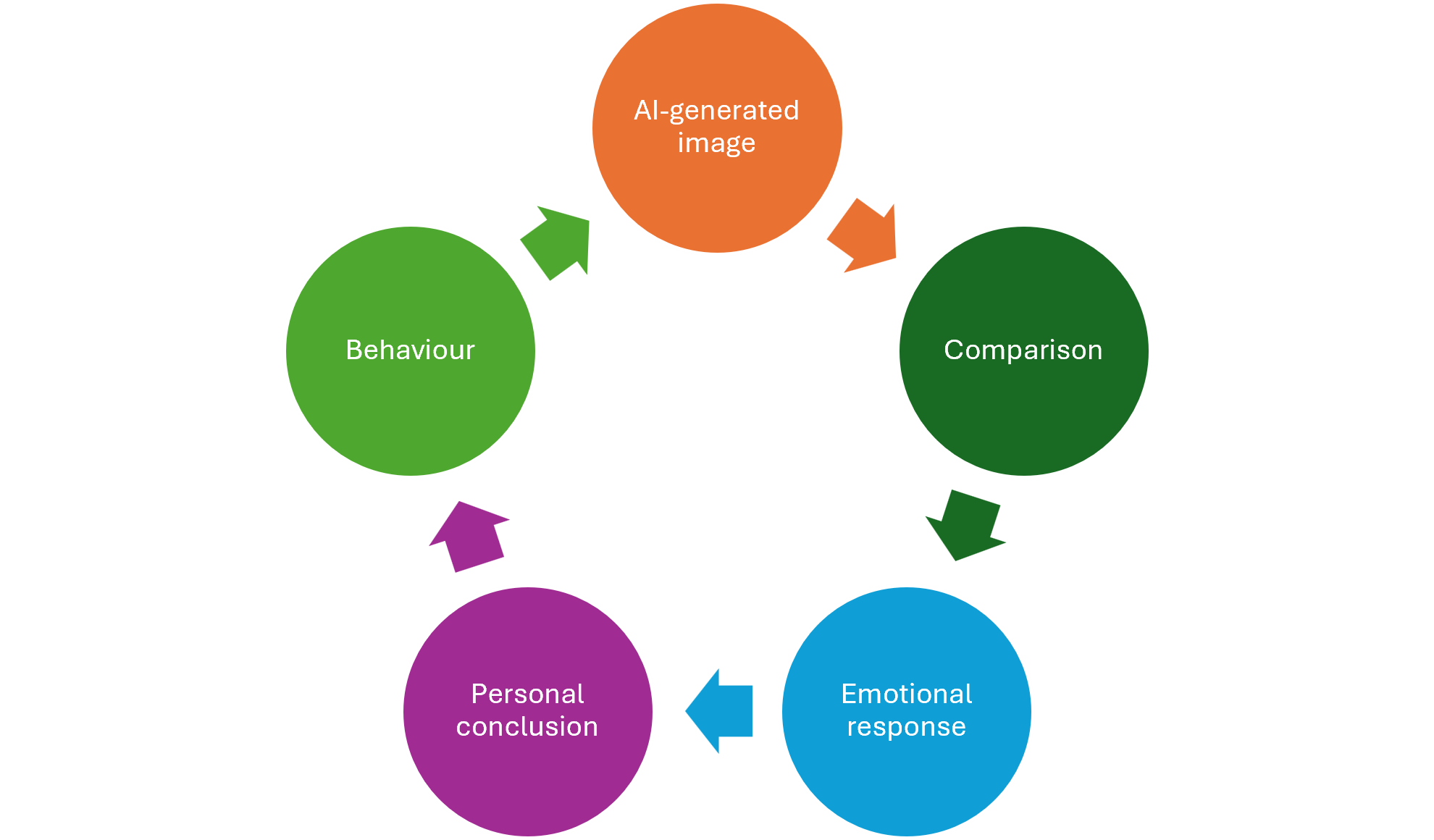
As the client reflects on each step, the process often becomes easier to understand. The image itself may evoke comparison. The comparison gives rise to painful emotions. Those emotions are interpreted as evidence that something is fundamentally wrong with the self.
The resulting behaviours – checking mirrors, avoiding photographs, restricting food, excessive exercise, endlessly editing images, or withdrawing from social situations – may temporarily reduce distress, yet ultimately reinforce the original belief. Instead of asking clients to “stop comparing,” the therapist is helping them become curious about the pathway through which comparison becomes suffering.
Sometimes the conversation naturally reaches a deeper question. A client may begin by saying,
“I wish I looked like her.”
As therapy unfolds, however, another possibility may emerge. “If you did look like her, what do you imagine would become possible that feels difficult today?”
Clients’ answers are often revealing:
- “People might actually notice me.”
- “I’d finally feel confident.”
- “Maybe I’d stop feeling like a failure.”
- “I’d feel as though I was enough.”
Notice how quickly the conversation has moved beyond appearance. Without dismissing the body, therapy has gently uncovered the deeper hopes, fears, and assumptions that have attached themselves to it.
The body as the place where broad identity questions are asked
This is not an attempt to persuade clients that appearance “doesn’t matter.” For many people, appearance carries profound emotional significance, and therapists honour that reality. Rather, the aim is to help clients discover that the body has gradually become the place where much broader questions about identity, belonging, competence, acceptance, and self-worth are being asked.
As this wider perspective develops, clients often find themselves relating to the mirror differently. Instead of treating every reflection as a final verdict on who they are, they begin recognising it as one source of information among many. The mirror may still speak, but it no longer has the only voice.
That shift rarely occurs in a single conversation. It develops gradually, through repeated moments of curiosity, compassion, and reflection. In many ways, the therapist’s role is not to replace one mirror with another. It is to help clients discover that they are able to look into the mirror without allowing it to become the sole author of their story.
Beyond the mirror: Reclaiming a broader sense of self
As therapy progresses, an interesting shift often begins to occur. At first, the mirror appears to hold extraordinary authority. A single image, photograph, or AI-generated face seems capable of determining how clients feel about themselves for the rest of the day. Their emotional wellbeing rises and falls with each comparison, and the reflection gradually becomes the measure against which their worth is judged.
Over time, however, something quieter and more enduring begins to develop. The goal of therapy is not to persuade clients that appearance is irrelevant, nor to encourage them to avoid every image that evokes comparison. Such an approach would leave the mirror holding its power, even if it were temporarily hidden from view. Instead, therapy seeks to help clients build a broader and more resilient understanding of themselves – one that cannot be reduced to a single reflection.
This reconstruction rarely occurs through insight alone. It develops gradually as clients begin discovering additional ways of knowing themselves. For some, this involves reconnecting with personal values that have become overshadowed by relentless appearance concerns. Others rediscover relationships in which they experience acceptance rather than evaluation. Some learn to appreciate what their bodies enable them to do rather than focusing exclusively on how their bodies appear. Others begin practising self-compassion, recognising that they have been applying standards to themselves that they would never expect another human being to meet (Neff, 2011; Hayes et al., 2012).
Identity distribution supports the self
As these experiences accumulate, something important begins to change. The client’s identity gradually becomes distributed across many different sources rather than concentrated almost entirely within appearance. Their sense of self becomes supported by relationships, values, acts of kindness, creativity, work, humour, spirituality, learning, contribution, and countless other aspects of living that make up a human life. Appearance does not disappear, but it no longer carries the impossible burden of answering every question about worth or belonging (Kernis, 2003; Rogers, 1961).
This broader foundation often changes the way clients encounter AI-generated images. The images themselves may look exactly as they did before. The algorithms have not changed. The standards portrayed by the images may remain just as unrealistic. Yet the person looking into the mirror is no longer the same.
Where comparison once led almost automatically to self-condemnation, clients may now notice the comparison without becoming completely defined by it. They recognise the familiar pull towards self-criticism, but they also recognise that it is only one possible response. New perspectives, developed through therapy, begin quietly competing with the old conclusions (Hayes et al., 2012; Gross, 2015).
No surrender to the mirror
The mirror has not changed. The relationship with the mirror has. Rather than erasing earlier experiences, therapy often helps clients reinterpret them within a broader and more compassionate life narrative, allowing old experiences to acquire new meanings (McAdams & McLean (2013).
For many therapists, this represents one of the most hopeful aspects of working with body image in the age of artificial intelligence. The aim is not to eliminate every unrealistic image from a client’s world – an impossible task – but to strengthen the person’s capacity to encounter those images without surrendering their identity to them (Neff, 2011; Siegel, 2020).
This perspective also encourages a more balanced conversation about artificial intelligence itself. AI is neither inherently harmful nor inherently beneficial. Like many powerful technologies, its influence depends partly upon the relationship people develop with it. Some individuals may find AI becomes another relentless source of comparison and self-criticism. Others may use the same technology creatively, educationally, or even therapeutically. The technology matters, but the meanings attached to it matter just as much (Sundar, 2015, Dwivedi et al., 2023).
Conclusion: A spiral of discernment
Perhaps this is the deepest therapeutic lesson. Human beings have always encountered mirrors. Some have reflected acceptance. Others have reflected criticism. Some have helped people discover themselves (Bowlby, 1990; Winnicott, 1971). Others have encouraged them to lose themselves. Artificial intelligence has added new mirrors to that long human story.
Therapy cannot remove every mirror. Nor should it. Instead, it helps people become increasingly discerning about which reflections deserve to shape the way they understand themselves. When that happens, clients often discover that they can return to the very images that once overwhelmed them and see something different. Not because the reflection has changed. But because they have.
The journey has not brought them back to where they began. It has brought them back with greater freedom, greater compassion, and a more spacious understanding of who they are. Like a spiral rather than a circle, they revisit familiar reflections from a new level of psychological development. The mirror still exists, but it no longer defines the person standing before it. In the end, perhaps the most enduring goal of therapy is not to teach clients how to avoid mirrors. It is to help them remember that no mirror, whether made of glass or generated by artificial intelligence, is capable of telling the whole story of a human life.
Key takeaways
- Artificial intelligence is introducing new ways for people to compare themselves with idealised images, yet the psychological processes involved are not entirely new. Rather than creating human vulnerability, AI often amplifies longstanding ways in which people evaluate themselves.
- Body image concerns are rarely only about appearance. For many clients, distress about the body reflects deeper questions concerning identity, belonging, worth, acceptance, and self-evaluation.
- Therapists need not begin by explaining how AI-generated images work. More often, it is helpful to begin by understanding what those images have come to mean for the individual client.
- Clients experiencing severe body image distress should be carefully assessed for body dysmorphic disorder, eating disorders, self-harm, suicidal ideation, and other significant clinical concerns. Exploration of AI-related influences should complement – not replace – evidence-based assessment, risk management, and referral where appropriate.
- Rather than asking clients to stop comparing themselves, therapy can help them become curious about the pathway linking comparison, emotional distress, personal conclusions, and behaviour.
- As therapy progresses, the focus gradually widens from appearance to the broader beliefs clients hold about themselves. This allows body image concerns to be understood within the wider context of identity development and self-worth.
- Recovery does not require eliminating every unrealistic image or avoiding every AI-generated representation. Instead, clients can gradually develop a broader, more resilient sense of self that enables them to encounter these images without allowing them to define who they are.
- Artificial intelligence may be changing the mirrors through which people come to know themselves. Therapy helps ensure that those mirrors do not become the only source from which identity is constructed.
Questions therapists often ask
Q. Should I encourage clients to stop using AI image generators or social media altogether?
A. For some clients, reducing exposure to triggering content may be an important part of treatment, particularly when body image concerns are severe. However, the longer-term therapeutic goal is usually not complete avoidance but helping clients develop the psychological flexibility to encounter idealised images without allowing those images to determine their sense of worth.
Q. How do I know when body image concerns require specialist referral?
A. Persistent preoccupation with perceived flaws, significant restriction of eating, bingeing or purging behaviours, compulsive checking or avoidance, rapid weight change, marked functional impairment, self-harm, or suicidal ideation all warrant careful assessment and may indicate the need for specialist eating disorder or body dysmorphic disorder services. Therapists should always work within their scope of competence and follow local risk-management procedures.
Q. What if a client already knows the images are AI-generated but still feels distressed?
A. This is a common experience. Intellectual knowledge rarely overrides emotional learning. Rather than repeatedly reminding clients that the images are artificial, it is often more helpful to explore the personal meanings that have become attached to those images and the conclusions clients draw about themselves when making comparisons.
Q. How can I gently move the conversation beyond appearance without making clients feel dismissed?
A. Therapists need not move away from the body too quickly. Instead, they can begin with compassionate curiosity about the client’s lived experience before gradually exploring what the body has come to represent. Questions about belonging, acceptance, confidence, identity, and self-worth often emerge naturally once clients feel understood rather than corrected.
Q. What is the central therapeutic task when working with AI-related body image concerns?
A. The goal is not to persuade clients that appearance does not matter, nor to convince them simply to think more positively. Rather, therapy helps clients develop a broader and more compassionate understanding of themselves so that appearance becomes one important aspect of identity rather than the sole measure of personal worth. In doing so, clients can gradually return to the same “AI mirror” from a different place – more resilient, more self-aware, and less defined by the reflection before them.
References
- Bowlby, J. (1990). A secure base: Parent-child attachment and healthy human development. Basic Books. ISBN-13: 978-0465075973 ISBN-10: 0465075975
- Cooley, C. H. (1902/1964). Human nature and the social order. New York: Charles Scribner’s sons.
- Dwivedi, Y.K., Kshetri, N., Hughes, L, Slade, E.L. et al., (2023). “So, what if ChatGPT wrote it?” Multidisciplinary perspectives on opportunities, challenges and implications of generative conversational AI for research, practice and policy. International Journal of Information Management, 71, 102642. https://doi.org/10.1016/j.ijinfomgt.2023.102642
- Fardouly, J., & Vartanian, L. R. (2016). Social media and body image concerns: Current research and future directions. Current Opinion in Psychology, 9, 1–5. https://doi.org/10.1016/j.copsyc.2015.09.005
- Festinger, L. (1954). A theory of social comparison processes. Human Relations, 7(2), 117–140. https://doi.org/10.1177/001872675400700202
- Gross, J. J. (2015). Emotion regulation: Current status and future prospects. Psychological Inquiry, 26(1), 1–26. https://doi.org/10.1080/1047840X.2014.940781
- Hayes, S. C., Strosahl, K. D., & Wilson, K. G. (2012). Acceptance and commitment therapy: The process and practice of mindful change (2nd ed.). The Guilford Press.
- Kernis, M. H. (2003). Toward a conceptualization of optimal self-esteem. Psychological Inquiry, 14(1), 1–26. https://doi.org/10.1207/S15327965PLI1401_01
- McAdams, D. P., & McLean, K. C. (2013). Narrative identity. Current Directions in Psychological Science, 22(3), 233–238. https://doi.org/10.1177/0963721413475622
- National Institute for Health and Care Excellence. (2020). Eating disorders: Recognition and treatment (NICE Guideline NG69). https://www.nice.org.uk/guidance/ng69
- National Institute for Health and Care Excellence. (2024). Obsessive-compulsive disorder and body dysmorphic disorder: Treatment (Clinical Guideline CG31). https://www.nice.org.uk/guidance/cg31
- Neff, K. D. (2011). Self-compassion: The proven power of being kind to yourself (Updated ed.). Hodder & Stoughton.
- Rogers, C. (1961). On becoming a person: A therapist’s view of psychotherapy. Boston: Houghton Miflin.
- Siegel, D. J. (2020). The developing mind (3rd ed.). Guilford Press.
- Sundar, S. S. (Ed.). (2015). The handbook of the psychology of communication technology. John Wiley and Sons, Inc. ISBN 1118426452, 9781118426456
- Tiggemann, M., & McGill, B. (2004). The role of social comparison in the effect of magazine advertisements on women’s mood and body dissatisfaction. Journal of Social and Clinical Psychology, 23(1), 23–44. https://doi.org/10.1521/jscp.23.1.23.26991
- Winnicott, D. W. (1971). Playing and reality. Routledge.