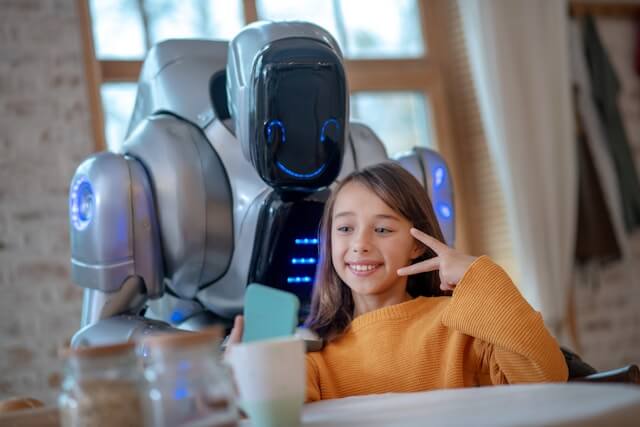


As AI becomes part of everyday life, how might it influence relationships? This article explores what therapists need to know about clients’ changing conversational worlds.
Related articles: Working with Loneliness: Interventions to Support Lonely Clients, Ethical Use of Artificial Intelligence in Mental Health Care.
Jump to section
- Introduction
- We speak differently to machines than to people
- Human conversation is more than an exchange of words
- Can AI reduce loneliness – and still leave us lonely?
- Bringing the conversation into the therapy room
- Looking beyond artificial intelligence: Not a conclusion
- Key Takeaways
- Questions therapists often ask
- References
Introduction
“I know this sounds strange,” Sarah said with a hesitant smile, “but sometimes I find it easier to talk to ChatGPT than to my husband.”
She looked almost apologetic as she continued.
“It never gets impatient. I can ask the same question five different ways and it never tells me I’m overthinking. I don’t have to worry about choosing the right words, and I don’t feel guilty if I need reassurance again.”
Sarah was not describing social isolation. She had been happily married for almost twenty years, enjoyed close friendships, and was successful in her career. Nor was she suggesting that an artificial intelligence could replace the people she loved. Rather, she was describing something much subtler: a new kind of conversational experience that had quietly become part of her daily life.
As mental health professionals, we are beginning to hear similar observations from clients. Some use AI to organise their thoughts before difficult conversations. Others use it to rehearse what they might say to a partner, employer, or family member. Some appreciate having an endlessly patient sounding board for processing emotions, while others simply enjoy the feeling of being able to explore an idea without interruption or fear of criticism. For many, these interactions are entirely adaptive and serve as useful complements to human relationships.
Yet Sarah’s comment also raises an intriguing clinical question. If millions of people are now engaging in conversations with systems that never become irritated, never need emotional support themselves, never ask us to compromise, and never insist that we attend to their needs, how might those experiences influence the conversational habits we carry into our relationships with other human beings?
This question is not an argument against artificial intelligence. Every significant communication technology – from the telephone to email, text messaging, and social media – has altered how we relate to one another in ways that were initially difficult to predict. Artificial intelligence represents another step in that evolution. Like earlier technologies, it offers remarkable opportunities while also inviting us to consider how repeated patterns of interaction may shape our expectations, our communication styles, and even our sense of connection over time.
Psychology has long recognised that human beings are profoundly influenced by repeated experiences. The principles of social learning (Bandura, 1977), habit formation (Wood & Rünger, 2016), and interpersonal neurobiology (Siegel, 2020) all remind us that the brain continually adapts to the environments in which it operates. Repeated behaviours become familiar; familiar behaviours become efficient; and efficiency often encourages repetition. In other words, we do not simply use conversational patterns – we gradually internalise them.
A new conversational environment
From this perspective, artificial intelligence becomes more than another digital tool. It creates a new conversational environment. Unlike human relationships, interactions with AI are typically characterised by immediate responsiveness, unlimited patience, and an absence of reciprocal emotional needs. Whether these differences ultimately enrich, diminish, or simply diversify our interpersonal lives remains an open empirical question. What matters clinically is not assuming that such interactions are either beneficial or harmful, but becoming curious about how clients are integrating them into their relational worlds.
In this article, the first of our series, Living Well in an AI World, we explore what current psychological research can – and cannot yet – tell us about the ways artificial intelligence may be influencing communication, empathy, reciprocity, and human connection. Rather than asking whether AI is “good” or “bad,” we invite a different question: As conversations with artificial intelligence become increasingly commonplace, what kinds of conversational habits are we practising, and what might those habits mean for the relationships that matter most?
We speak differently to machines than to people
One of the most striking features of interacting with artificial intelligence is not what we say, but how we say it.
Most of us instinctively communicate differently with machines than with people. We issue brief commands to navigation systems (“Take me home”), search engines (“Best Italian restaurant near me”), or virtual assistants (“Set a timer for ten minutes”). Efficiency, rather than social connection, has traditionally defined these interactions. Generative AI extends this pattern into something much richer: conversation. Yet despite the conversational format, many interactions remain fundamentally transactional. The AI is expected to respond immediately, accommodate repeated requests without frustration, and adapt continually to the user’s needs.
Reciprocal human conversations
Human conversations operate very differently. They are reciprocal by nature. They involve turn-taking, negotiation, clarification, moments of misunderstanding, and subtle emotional adjustments that occur almost continuously (Clark, 1996). We monitor facial expressions, vocal tone, pauses, and gestures while simultaneously considering another person’s perspective, intentions, and emotional state. These processes draw upon sophisticated social-cognitive capacities, including perspective-taking, empathy, and mentalising (Frith & Frith, 2006).
Artificial intelligence does not require these reciprocal adjustments. It does not become offended by bluntness, bored by repetition, or emotionally burdened by our disclosures. Indeed, one reason many users describe AI as psychologically “easy” is precisely because it removes many of the interpersonal demands that accompany human relationships.
Repeated behaviours become automatic – including conversational styles
From a clinical perspective, however, this raises an interesting possibility. Psychology has consistently demonstrated that repeated behaviours become increasingly automatic over time (Wood & Rünger, 2016). Communication styles are no exception. If a person spends considerable time engaging in highly efficient, one-directional conversations in which they need not monitor another mind, might aspects of that conversational style gradually become more familiar – or even spill over – into interactions with family members, friends, colleagues, or partners?
At present, the empirical evidence remains limited, and definitive conclusions would be premature. Nevertheless, adjacent research offers reasons to approach the question thoughtfully. Studies of digital communication have shown that communication technologies can subtly influence expectations regarding responsiveness, attention, and conversational norms (Hall, Baym, & Miltner, 2014). Similarly, work in media psychology suggests that repeated interaction with particular communication environments can shape social expectations and behavioural scripts over time (Sundar, 2015). Artificial intelligence introduces an entirely new communicative environment, making it reasonable to ask whether similar processes may eventually emerge.
Importantly, this is not a call to discourage clients from using AI. Many individuals report that conversational AI reduces anxiety before difficult discussions, assists with emotional articulation, or provides a valuable space for reflection. These are potentially meaningful psychological benefits. The therapeutic task is therefore not to judge AI use but to remain curious about how these interactions fit within the broader ecology of a client’s relationships. As therapists, we may increasingly find ourselves asking not only what clients are discussing with AI, but how those conversations might be influencing the ways they relate to the people around them.
Human conversation is more than an exchange of words
At first glance, conversations with artificial intelligence can feel remarkably similar to conversations with another person. We ask questions, describe problems, seek advice, tell stories, and receive coherent responses. The familiar rhythm of dialogue can make it easy to overlook a fundamental difference: one participant in the conversation has no personal needs, no emotional investment in the interaction, and no subjective experience of the exchange.
That distinction matters because, psychologically, human conversation has never been simply about transmitting information. It is one of the primary ways in which we build relationships, negotiate differences, repair misunderstandings, and regulate emotion together. Every meaningful conversation involves two minds continually adjusting to one another, often in ways that neither person consciously notices (Siegel, 2020).
Consider, for example, what happens during an ordinary discussion between close friends. One person hesitates before answering a difficult question. The other notices the pause and softens their tone. A joke falls flat, prompting an awkward silence that is gently repaired with a smile or an apology. One friend becomes visibly upset, and the other instinctively shifts from offering solutions to simply listening. These micro-adjustments occur countless times during even brief conversations. They require empathy, perspective-taking, emotional regulation, and what developmental psychologists describe as mentalising – our capacity to recognise that another person has thoughts, feelings, intentions, and beliefs that may differ from our own (Fonagy et al., 2002; Frith & Frith, 2006).
Most of these processes unfold beneath conscious awareness. We rarely stop to think, “Now I must consider my friend’s emotional state before choosing my next sentence.” Instead, years of social learning have made these adjustments feel natural. Conversation becomes a kind of interpersonal dance in which each person’s movements subtly influence the other’s.
Artificial intelligence changes the choreography
When interacting with AI, we are freed from many of the interpersonal demands that ordinarily accompany conversation. We do not need to worry about hurting its feelings, monopolising the discussion, or noticing signs of fatigue. We are under no obligation to ask how it is coping, whether it agrees with us, or whether it would prefer to change the subject. The interaction is intentionally designed to revolve around the user’s goals.
Importantly, this is not a flaw in AI; it is one of its defining features. Many users find these qualities enormously beneficial. Individuals experiencing social anxiety, for example, may appreciate being able to rehearse difficult conversations without fear of embarrassment. Clients who struggle to organise their thoughts often report that conversational AI helps them clarify emotions before speaking with a loved one or therapist. Others value the opportunity to explore ideas without worrying that they are taking up too much of another person’s time. In these contexts, AI may function as a supportive psychological scaffold rather than a substitute for human connection.
The question for clinicians is therefore not whether these interactions are helpful. Frequently, they are. Rather, it is whether repeated experiences of one kind of conversational environment might subtly shape expectations about another.
Psychological research suggests that repeated behavioural contexts often give rise to what cognitive scientists refer to as behavioural scripts – internal templates that guide how we expect familiar situations to unfold (Schank & Abelson, 1977). Once established, these scripts reduce cognitive effort by allowing us to respond automatically to recurring situations. We see this in everything from restaurant etiquette to workplace meetings and family rituals. Conversation itself relies heavily on such scripts.
This raises a fascinating possibility. As people spend increasing amounts of time engaging with conversational AI, are they also beginning to develop new conversational scripts? If so, what expectations might accompany those scripts? Immediate responsiveness? Unlimited patience? Conversations that rarely require compromise? The ability to return repeatedly to one’s own concerns without needing to attend to another’s emotional experience?
At present, these questions remain largely unanswered by empirical research. Yet they represent precisely the kind of subtle psychological shifts that therapists are uniquely positioned to observe long before longitudinal studies can provide definitive answers. Indeed, clinicians have often recognised emerging patterns of human behaviour years before researchers possessed the tools to measure them systematically.
Perhaps, then, one of our most important tasks is simply to begin noticing:
- Noticing how clients describe their conversations with AI.
- Noticing whether those conversations supplement or replace human relationships.
- Noticing whether AI becomes a rehearsal space for greater intimacy – or a refuge from the inevitable complexity of relating to another imperfect human being.
These are not questions of pathology. They are questions of adaptation. Like every significant change in our social environment, conversational AI invites us to become curious about how human beings accommodate new ways of connecting while preserving the relational capacities that have always underpinned psychological wellbeing.
Clinical pearl: Listen not only for what clients use AI for, but how they describe the experience. Words such as easier, safer, less complicated, always available, or never judges me may reveal important information about the interpersonal needs being met. Rather than viewing these observations as evidence for or against AI use, they can serve as valuable starting points for exploring clients’ broader relational worlds.
Can AI reduce loneliness – and still leave us lonely?
Loneliness has become one of the defining public health concerns of the twenty-first century. Across many countries, increasing numbers of people report feeling socially disconnected despite living in an era of unprecedented digital connectivity (World Health Organization, 2025). At the same time, conversations with artificial intelligence are becoming an increasingly ordinary part of daily life. For some individuals, AI offers companionship during quiet evenings, a space to organise difficult thoughts, or simply the reassuring experience of being able to “talk something through” without feeling that they are burdening another person.
Seen from this perspective, it is hardly surprising that many people describe conversational AI as comforting. Human beings are profoundly social creatures. When opportunities for connection are limited – whether through geographical isolation, illness, bereavement, disability, caregiving responsibilities, or social anxiety – we naturally seek alternative ways to satisfy our need for interaction and emotional regulation. Rather than viewing AI use as inherently concerning, clinicians may first wish to ask a simpler and more compassionate question: What need is this technology helping to meet?
That question shifts the therapeutic focus away from the technology itself and back towards the person using it.
Psychologists have long distinguished between being alone and feeling lonely. Solitude can be restorative, creative, and deeply nourishing, while loneliness reflects the subjective experience that one’s desired level of meaningful connection exceeds what is currently available (Cacioppo & Cacioppo, 2018). Simply increasing the number of interactions a person has does not necessarily reduce loneliness; what matters is the perceived quality, reciprocity, and emotional significance of those connections.
AI reduces immediate loneliness distress
Conversational AI enters this landscape in an intriguing way. It may reduce some of the immediate distress associated with loneliness by providing responsiveness, engagement, and an opportunity for self-expression. Users frequently report feeling heard, understood, or less isolated after extended interactions with conversational systems. These experiences should not be dismissed simply because the conversational partner is artificial. If a client finishes an interaction feeling calmer, more organised, or less overwhelmed, those outcomes are psychologically meaningful.
Yet another question remains. Can an interaction relieve the feeling of loneliness without fully satisfying the relational needs that gave rise to it?
Attachment theory reminds us that secure relationships are characterised not merely by responsiveness, but by mutual influence. We affect one another. We experience delight in another person’s delight, comfort in another person’s presence, and sometimes frustration when another person’s needs differ from our own (Bowlby, 1990; Cassidy & Shaver, 2016). Human relationships involve negotiation, unpredictability, repair, forgiveness, and shared history. These qualities can occasionally make relationships exhausting – but they are also part of what gives them emotional depth.
Conversational AI offers a different relational experience. It is reliably attentive, consistently available, and intentionally oriented towards the user’s needs. For many people, these qualities are enormously valuable. However, because the interaction is asymmetrical, it does not ask us to participate in the ongoing mutual regulation that characterises human attachment relationships.
Again, this difference should not automatically be interpreted as a deficit. Rather, it invites curiosity about the distinct psychological functions that different kinds of relationships may serve.
AI may support emotional scaffolding
Perhaps conversational AI is best understood as emotional scaffolding.
Just as physical scaffolding temporarily supports a building while more permanent structures are strengthened, conversational AI may sometimes support emotional functioning while people prepare for more difficult human conversations, organise overwhelming experiences, or practise expressing vulnerable thoughts.
Used in this way, AI becomes a bridge. The clinical question is whether it remains a bridge – or gradually becomes the destination. That distinction may prove far more important than the amount of AI a person uses.
For therapists, these distinctions suggest that conversations about AI may increasingly resemble conversations we already have about friendships, family relationships, social media, online gaming, work, or any other aspect of a client’s relational world. The goal is not to determine whether AI is “good” or “bad,” but to understand the place it occupies within the client’s broader ecology of connection.
Bringing the conversation into the therapy room
For many therapists, conversations about artificial intelligence are likely to become increasingly commonplace over the coming years. Yet these discussions need not feel fundamentally different from conversations we already have about friendships, romantic relationships, work, social media, gaming, or family dynamics. In each case, our interest lies less in the activity itself than in the psychological functions it serves within a person’s life.
This distinction is important. If we approach AI primarily as a technological issue, we may find ourselves asking questions about software, privacy, or frequency of use. While these topics certainly have their place, they are not usually the questions that reveal the richest therapeutic material.
Psychotherapy has always been more interested in relationships than in objects. Whether the “other” is a parent, a partner, a career, a smartphone, or now an artificial intelligence, therapists naturally become curious about the meanings, expectations, and emotional experiences attached to that relationship. From this perspective, conversations about AI become conversations about human needs.
Looking beyond the technology
Imagine that a client tells us,
“I ask ChatGPT almost everything now.”
Our immediate task is not to determine whether this represents healthy adaptation or problematic dependence.
Instead, we might begin wondering:
- What role has AI come to occupy in this person’s emotional world?
- What experiences does it provide that feel difficult to find elsewhere?
- When does the client reach for AI rather than another person?
- What happens afterwards?
These questions shift our attention away from the technology and towards patterns of relating. After all, two clients may use AI in superficially similar ways while the underlying psychological processes differ enormously. One client may use conversational AI to organise overwhelming thoughts before speaking honestly with a partner. Another may gradually withdraw from increasingly challenging human interactions because AI feels emotionally simpler. Externally, the behaviour appears almost identical. Clinically, however, the formulation could hardly be more different.
This reminds us of an enduring therapeutic principle: behaviours rarely explain themselves. Their meaning emerges only when understood within the context of the person’s broader relational life (Fonagy et al., 2002; Siegel, 2020).
Curiosity before conclusion
One of the most valuable contributions therapists may bring to this emerging area is a willingness to resist premature conclusions.
When confronted with new technologies, societies often oscillate between enthusiasm and alarm. Psychology has witnessed similar cycles surrounding television, video games, smartphones, and social media. While each technology undoubtedly introduced genuine challenges, the psychological impact ultimately depended less upon the technology itself than upon how individual people incorporated it into their lives (Sundar, 2015).
Artificial intelligence is unlikely to prove any different. Some clients may discover that AI expands confidence, improves communication, and encourages deeper engagement with other people. Others may find that it quietly reinforces avoidance, perfectionism, reassurance-seeking, or social withdrawal. Most will probably experience some combination of benefits and limitations. The therapist’s task is not to predict which outcome will occur. It is to notice. To ask. To understand (Siegel, 2020). Only then can intervention become genuinely person-centred (Rogers, 1961).
Clinical pearl: When clients describe their interactions with AI, listen for the relational verbs.Do they say they consult it, confide in it, depend on it, practise with it, escape into it, or learn from it?These verbs often reveal more about the client’s psychological relationship with AI than the amount of time they spend using it.
A conversation in the consulting room
“You mentioned that you’ve been talking with AI most evenings.”
“Yes.”
“What do you find yourself going there for?”
“Mostly… to untangle my thoughts.”
“What does it give you that feels particularly helpful?”
“I never feel judged.”
“That sounds important.”
“It is.”
“I’m wondering… after you’ve untangled everything with AI, what helps you take those thoughts into your relationships with other people?”
The room falls quiet.
“Actually…” the client says after a long pause.
“I don’t think I usually do.”
Notice that the therapeutic turning point did not occur because the therapist challenged the client’s use of AI.
Nor did it occur because AI was framed as either beneficial or harmful.
Instead, the therapist gently expanded the conversation.
The focus shifted from
What happens between you and AI?
to
What happens between you and other people after you’ve spoken with AI?
That subtle change opens an entirely different therapeutic landscape.
Looking beyond artificial intelligence: Not a conclusion
The emergence of conversational AI undoubtedly introduces new questions for psychologists, therapists, educators, and society more broadly. Yet perhaps its greatest contribution to psychological thinking will not be the technology itself, but the opportunity it provides to observe human relationships from an unexpected angle.
Throughout this article, we have considered whether repeated conversations with AI might influence communication styles, expectations, loneliness, and interpersonal habits. These questions deserve careful empirical investigation, and many remain unanswered. As with every significant technological development, some consequences will almost certainly prove beneficial, others challenging, and many will depend upon the contexts in which the technology is used.
Illuminating as well as shaping
Yet another possibility has gradually emerged. Perhaps conversations with AI do not simply shape relationships. Perhaps they also illuminate them. When clients describe AI as endlessly patient, consistently accepting, emotionally safe, or always available, they may be telling us something profound – not primarily about artificial intelligence, but about the kinds of relationships they have longed for, missed, feared losing, or struggled to find (Cassidy and Shaver, 2016; Fonagy et al., 2002).
In this sense, AI becomes less a substitute for human connection than a mirror reflecting enduring relational needs (Bowlby, 1990; Cassidy & Shaver, 2016). For therapists, that distinction changes everything. The clinical task is no longer deciding whether AI use should be encouraged or discouraged. Instead, it becomes an invitation to ask deeper questions.
- What emotional needs are being met here?
- Which relational experiences feel absent elsewhere?
- How might these interactions help us understand the client’s attachment history, interpersonal expectations, or unmet longings?
Suddenly, AI is no longer the destination of therapeutic curiosity. It is the doorway.
Experts in curiosity needed more than experts in AI
Perhaps one day we will look back on the arrival of conversational AI in much the same way that psychologists now look back on the arrival of social media or smartphones – not as events that fundamentally changed human nature, but as developments that revealed new ways in which enduring aspects of human nature express themselves.
Human beings have always sought understanding. We have always sought reassurance. We have always rehearsed difficult conversations before having them. We have always longed to be heard without judgment. Artificial intelligence has not created these needs. It has simply offered a new environment in which they become visible. Perhaps that is why therapists need not become experts in artificial intelligence nearly as much as they need to remain experts in being curious about people
Artificial intelligence will undoubtedly continue to evolve, and with it, the ways in which people communicate, seek support, and make sense of their lives. Therapists need not rush to embrace every innovation, nor resist it simply because it is new. Instead, we can do what our profession has always done best: listen carefully, notice patterns, remain curious, and help clients understand themselves more deeply. If conversations with AI ultimately help reveal the relational hopes, fears, and longings that have always shaped human connection, then perhaps this newest conversational partner has already given psychology one of its oldest gifts – a fresh opportunity to understand what it means to relate, to belong, and to flourish.
Key takeaways
- Artificial intelligence introduces a new conversational environment, not simply a new technology. As clients increasingly engage with AI in everyday life, therapists have an opportunity to explore how these interactions fit within the client’s broader relational world.
- Human conversations are characterised by mutuality, reciprocity, emotional negotiation, and shared influence. Conversations with AI are intentionally different, offering responsiveness without reciprocal emotional demands.
- Current evidence does not support viewing AI conversations as inherently beneficial or inherently harmful. Their psychological impact depends on how, why, and in what context individuals use them.
- AI may function as emotional scaffolding, helping clients organise thoughts, rehearse difficult conversations, regulate emotions, or reduce loneliness before engaging with other people.
- An important clinical question is whether AI serves primarily as a bridge towards richer human relationships or gradually becomes a destination that replaces opportunities for mutual connection.
- Clients’ descriptions of AI often reveal enduring interpersonal needs. Statements such as “It never judges me,” “It’s always patient,” or “I can finally say everything I’m thinking” may illuminate longstanding attachment patterns, unmet relational needs, or fears of vulnerability.
- Therapists need not become experts in artificial intelligence nearly as much as they need to remain curious about how clients relate – to other people, to themselves, and increasingly, to intelligent technologies.
- Rather than asking whether AI is “good” or “bad,” clinicians may find it more helpful to ask: What role does AI play within this person’s ecology of relationships, and what does that role reveal about the client’s emotional world?
Questions therapists often ask
Q. Should I discourage clients from using conversational AI for emotional support?
A. Not necessarily. Current evidence suggests that conversational AI may help some people organise thoughts, reduce immediate distress, or rehearse difficult conversations. Rather than focusing first on the technology, therapists may wish to explore how and why the client is using AI, and whether those interactions ultimately strengthen or diminish engagement with meaningful human relationships.
Q. Could frequent conversations with AI make people less socially skilled?
A. At present, there is insufficient empirical evidence to draw firm conclusions. However, psychological research suggests that repeated behavioural patterns can become habitual over time. This makes it reasonable to explore whether conversational habits developed with AI influence expectations or behaviours within human relationships. The question remains an important area for future research.
Q. How can I introduce conversations about AI without sounding judgmental?
A. Approach AI in the same way you would explore any significant relationship or coping strategy – with curiosity rather than assumption. Open questions such as, “What do those conversations give you?” or “When do you find yourself turning to AI rather than another person?” often generate richer therapeutic material than questions focused on frequency of use alone.
Q. Could AI become a useful therapeutic resource?
A. Potentially, yes. Some clients may benefit from using AI to clarify thoughts, practise difficult conversations, generate reflective questions, or organise emotional experiences between sessions. Therapists can help clients integrate these tools intentionally while continuing to cultivate reciprocal human relationships and critical reflection.
Q. What is the most important thing therapists should remember as AI becomes increasingly common?
A. Artificial intelligence may be changing the context in which relationships develop, but the foundations of psychological wellbeing remain remarkably consistent. Curiosity, empathy, secure attachment, mutuality, belonging, and authentic human connection continue to be central to flourishing. Conversations about AI are therefore, at their heart, conversations about people.
References
- Bandura, A. (1977). Social learning theory. Prentice Hall. ISBN 10: 0138167516 ISBN 13: 9780138167516
- Bowlby, J. (1990). A secure base: Parent-child attachment and healthy human development. Basic Books. ISBN-13: 978-0465075973 ISBN-10: 0465075975
- Cacioppo, J. T., & Cacioppo, S. (2018). The growing problem of loneliness. The Lancet, 391(10119), 426. https://doi.org/10.1016/S0140-6736(18)30142-9
- Cassidy, J., & Shaver, P. R. (Eds.). (2016). Handbook of attachment: Theory, research, and clinical applications (3rd ed.). Guilford Press. ISBN 10 / ISBN 13: 1462525296 / 9781462525294
- Clark, H. H. (1996). Using language. Cambridge University Press. ISBN 10: 0521567459 ISBN 13: 9780521567459
- Fonagy, P., Gergely, G., Jurist, E. L., & Target, M. (2002). Affect regulation, mentalization, and the development of the self. Other Press.
- Frith, C. D., & Frith, U. (2006). The neural basis of mentalizing. Neuron, 50(4), 531-534. https://doi.org/10.1016/j.neuron.2006.05.001
- Hall, J. A., Baym, N. K., & Miltner, K. M. (2014).Put down that phone and talk to me: Understanding the roles of mobile phone norm adherence and similarity in relationships. – Mobile Media & Communication, 2(2):134-153.DOI – 10.1177/2050157913517684
- Hayes, S. C., Strosahl, K. D., & Wilson, K. G. (2012). Acceptance and commitment therapy: The process and practice of mindful change (2nd ed.). The Guilford Press.
- Rogers, C. (1961). On becoming a person: A therapist’s view of psychotherapy. Boston: Houghton Miflin.
- Schank, R. C., & Abelson, R. P. (1977). Scripts, plans, goals and understanding: An inquiry into human knowledge structures. Lawrence Erlbaum. ISBN 10: 0898591384 ISBN 13: 9780898591385
- Siegel, D. J. (2020). The developing mind (3rd ed.). Guilford Press.
- Sundar, S. S. (Ed.). (2015). The handbook of the psychology of communication technology. John Wiley and Sons, Inc. ISBN 1118426452, 9781118426456
- Wood, W., & Rünger, D. (2016). Psychology of habit. Annual Review of Psychology, 67, 289-314. https://doi.org/10.1146/annurev-psych-122414-033417
- World Health Organization. (2025). Social connection: Overview. https://www.who.int