


This article explores what our online personas reveal about belonging, validation, and the selves we are becoming.
Related articles: When Machines Mirror Us: AI Bias and the Stories We Tell, Looking Into the AI Mirror, Teen Social Media Use and Mental Health: A Clinical Guide Beyond the Noise.
Jump to section
- Introduction: Who are you when you log on?
- What does this version of me do for me?
- When the audience gets inside the self
- Feeling close to someone who does not know us
- Growing up – and continuing to grow – online
- Bringing the digital self into the therapy room
- Conclusion: Remaining the author
- Key takeaways
- Questions therapists often ask
- References
Introduction: Who are you when you log on?
Most of us have encountered a version of someone online who seems slightly different from the person we know offline. Perhaps they are more outspoken on X, polished on LinkedIn, or playful in a gaming community. We may recognise the phenomenon closer to home: things we comfortably post in one digital space might feel distinctly odd – or alarmingly revealing – in another. It is tempting to frame these differences as a question of authenticity: which is the real person, and which is the performance?
Psychologically, that may be the wrong question. Human beings have always presented different aspects of themselves in different contexts. Digital environments have not invented the contextual self. What they have done is create powerful new environments in which aspects of identity can be selected, expressed, tested, reinforced, quantified, and preserved.
For therapists, this opens up a more useful inquiry. Rather than asking whether an online identity is “real”, we might ask: What does this version of the person allow them to express? What need does it meet? And what does it cost to maintain?
We have always had more than one self
A person might simultaneously maintain a professionally accomplished LinkedIn identity, an aesthetically curated Instagram presence, an irreverent group-chat persona, and an adventurous avatar in an online game. None need be fraudulent. Each may express something genuine, although none represents the whole person.
Recent work on identity development challenges approaches that separate digital life from “real life”. Granic et al. (2020), for example, describe young people as inhabiting a hybrid reality in which online and offline experiences interact. From this perspective, asking only how many hours someone spends online tells us relatively little. We also need to understand what they are doing there, with whom, and why. In other words, digital behaviour needs formulation, not merely measurement.
Consider two clients who each spend three hours every evening online. One participates in a community where she can explore aspects of herself that feel difficult to express elsewhere. The other spends those hours monitoring other people’s lives, deleting photographs that receive little engagement, and repeatedly checking whether a particular person has viewed his posts. The quantity of use is identical. Psychologically, almost everything else is different.
Digital environments can permit experimentation, connection, and self-expression. Someone inhibited face-to-face may discover confidence in an online community; another person may explore interests or identities before feeling ready to express them elsewhere. Sometimes an online self allows an aspect of the person to become visible for the first time.
When difference becomes discrepancy
There is, however, an important distinction between flexible self-presentation and a digital identity that becomes increasingly difficult to reconcile with lived experience. Curating what we show others is ordinary social behaviour. It becomes more clinically interesting when maintaining the presented self requires significant psychological labour.
In a study involving more than 10,000 Facebook users, more authentic self-expression was associated with greater life satisfaction. A subsequent preregistered longitudinal experiment also found that posting more authentically was associated with improved mood and affect (Bailey et al., 2020).
This does not mean psychological health requires posting every insecurity alongside the holiday photographs. Rather, it invites curiosity about discrepancy and its cost. One person may experience a polished online presence as playful selection. Another may feel compelled to sustain an image of success while privately experiencing burnout, financial insecurity, or self-doubt. A useful therapeutic question might therefore be: “How free do you feel to be different from the person people see online?”
What does this version of me do for me?
If we stop treating online identities primarily as evidence of authenticity or inauthenticity, another question becomes possible: What function does each identity serve?
Consider Maya, aged 34, who describes herself as quiet and socially cautious. At work she rarely speaks unless certain she has something useful to contribute. Online, Maya runs a popular account devoted to restoring vintage clothing. Her photographs are striking, her captions funny and opinionated. Thousands follow her, and she has developed friendships with other creators. Her followers, she tells her therapist, “know a completely different Maya”.
Yet Maya does not feel fraudulent online. She feels less inhibited. The expertise and humour are genuine. The digital environment has allowed characteristics that struggle to emerge face-to-face to become visible and socially recognised.
Increasingly, however, Maya worries when posts perform poorly and feels pressure to produce what followers expect. What began as expanded self-expression is acquiring rules.
Nothing about Maya’s online identity is simply “healthy” or “unhealthy”. Its significance lies in what it permits, what reinforces it, and how flexible it remains. Different digital identities may organise around different needs:
- Here, I am competent.
- Here, I belong.
- Here, somebody notices me.
- Here, I can experiment.
- Here, I can speak because nobody knows who I am.
Research on adolescent identity development supports this more differentiated approach to digital activity: self-presentation, active participation, social comparison, and feedback appear to relate differently to identity exploration and self-concept clarity (Avci et al., 2025).
The clinical task is not to decide which identities should be dismantled, but to understand the psychological work they are doing. An online identity may expand the person’s repertoire: I discovered that I can be funny, assertive, creative, or knowledgeable. Alternatively, it may become restrictive: I must be funny. I have to appear successful. I cannot let this audience see me uncertain.
At that point, the digital self is no longer simply expressing something. It may also be prescribing something.
Clinical Pearl: Rather than asking first whether an online identity is “authentic”, explore what becomes possible within it, what receives reinforcement, and what the client believes would happen if they stopped performing it.
This brings us to a distinctive feature of digital identity: unlike most social selves humans have inhabited historically, the digital self can receive continuous, visible, and numerical information about how well it is being received.
When the audience gets inside the self
Social feedback has always helped us understand who we are. We notice which jokes make people laugh, which achievements earn praise, and which behaviours threaten belonging.
Digital environments make aspects of this process unusually visible, persistent, and measurable. A photograph attracts 600 likes; another attracts 80. A thoughtful post disappears quietly while an angry one travels widely. Each encounter potentially contains information: People respond when I am like this. The information need not consciously register as a lesson to begin shaping behaviour.
When social approval acquires a number
Wanting social approval is not inherently shallow; belonging and recognition are human concerns. The clinically useful question is how much authority digital feedback has acquired in determining what someone thinks about themselves.
A young musician may use audience response to develop confidence and discover which performances resonate. Another may gradually become unable to judge whether a performance was worthwhile until she knows how many people watched it. In the second case, external evaluation has begun displacing internal evaluation.
Clients may reveal this shift in apparently casual statements:
- “I thought I looked good until I posted the photo.”
- “I was proud of it, but hardly anyone reacted.”
- “That post did really well, so apparently people like me when I’m more outrageous.”
Such comments tell us where the person is locating the authority to decide what is attractive, interesting, successful, or valuable.
Comparison and the imagined audience
Audiences do more than respond to us. We also watch them. Social comparison is an ordinary psychological process, but digital environments vastly increase access to comparison targets—often through highly selected representations. We may compare an ordinary Tuesday morning with someone else’s holiday photograph, career uncertainty with a promotion announcement, or a difficult relationship with an anniversary tribute. Research with adolescents suggests that social-media comparison is associated with both identity exploration and identity distress, while some evidence also links comparison with lower self-concept clarity (Avci et al., 2025).
Knowing intellectually that online presentations are selective does not necessarily prevent emotional comparison. Nor is comparison invariably harmful. It may provide information, motivation, hope or normalisation. Clinically, it is therefore more useful to ask who clients compare themselves with, on what dimensions, and what happens afterwards.
Repeated social evaluation also invites another possibility: we may begin anticipating the audience before it responds. Will colleagues think this sounds intelligent? Will friends wonder why they were not invited? Is this too political, ordinary, or revealing? The audience has, in effect, entered the editing room.
Maya experiences this when a restoration she particularly loves attracts little engagement. Nobody criticises her, yet she repeatedly checks the post. When choosing her next project, she catches herself thinking not What would I enjoy? but What will perform? That small substitution matters.
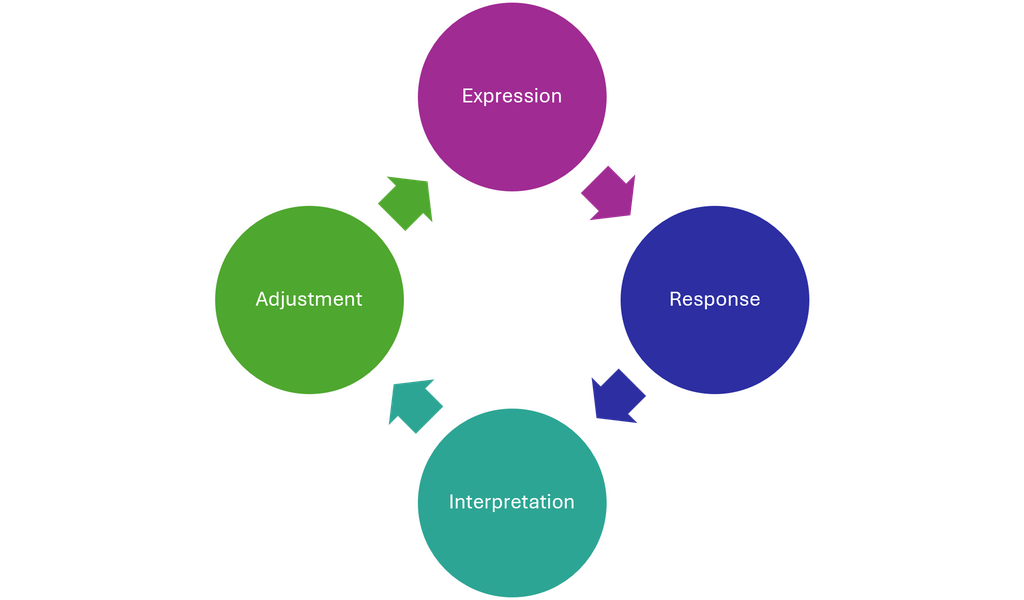
The feedback loop can be represented simply:
Expression → response → interpretation → adjustment → new expression (see Figure).
Figure: Social Evaluation Feedback Loop
Repeated often enough, it may teach us more than what attracts attention:
- People like me when I am funny.
- People notice me when I am attractive.
- People engage when I am angry.
- People admire me when I am successful.
The especially revealing therapeutic question may be: “What have you learned not to show?”
Feedback loops can also consolidate valuable identities. Encouragement from a writing community may help someone begin thinking of themselves as a writer; recognition within a professional community may strengthen emerging competence. The goal is not independence from other people’s responses. It is flexibility: can attention remain information without becoming a verdict?
Feeling close to someone who does not know us
Parasocial relationships are not a digital invention. People formed attachments to actors, musicians, and broadcasters long before social media. What has changed is access.
A favourite actor once appeared in films and occasional interviews. Today, a creator may appear on someone’s phone several times a day – talking from the kitchen, introducing the dog, discussing a breakup, or responding to followers. It can feel less like observing a public figure and more like keeping up with someone we know.
Parasocial relationships remain structurally one-sided: one person may know a great deal about the other, while the public figure knows little or nothing about the individual follower. Yet this does not make the follower’s experience of connection meaningless or necessarily unhealthy. Parasocial relationships can enhance feelings of connection and community, facilitate coping, and support personal development and identity exploration, while also carrying potential costs (Hoffner & Bond, 2022). A recent meta-analysis similarly found parasocial engagement associated with both positive and negative mental-health outcomes, with considerable variation according to outcome, developmental stage, cultural context, and type of parasocial engagement (Li et al., 2026).
These relationships can also become identity scaffolds:
- She lives the kind of life I want.
- He expresses things I have never been able to say.
- People like us understand the world this way.
The therapeutic issue is therefore not whether the attachment is “real enough”. Does it supplement reciprocal relationships or increasingly substitute for them? Does admiration expand possibilities or narrow them around imitation? What happens when the admired person changes, disappoints the follower, or reveals the limits of the perceived intimacy? The answers may tell us considerably more than whether a client follows celebrities or influencers.
Growing up – and continuing to grow – online
These questions are especially relevant during adolescence, when identity exploration and peer evaluation are developmentally salient. Yet evidence does not support a simple equation of greater social-media use with poorer mental health. An umbrella review of 25 reviews found that most characterised associations between social-media use and adolescent mental health as weak or inconsistent, although some reached more negative conclusions (Valkenburg et al., 2022).
For clinicians, this cautions against blanket assumptions. Two fifteen-year-olds using the same platform for the same number of hours may be having very different experiences. One may find friendship, creativity, and space for identity exploration; another may be caught in relentless comparison and monitoring. Most will probably experience some combination of benefits, pressures, and ordinary entertainment.
And digital identity does not cease to matter after adolescence. Adults continue negotiating identity through relationships, parenthood, work, migration, ageing, loss, and reinvention. The newly redundant professional may find LinkedIn unexpectedly painful. A recently divorced person may experiment with presenting a newly single self. A new parent may encounter hundreds of representations of how parenthood supposedly ought to look.
The developmental context changes, but useful clinical questions remain: “What part of yourself are you working out here?” “What does this environment help you become – and what does it make harder to be?” Rather than assuming that online life has a uniform psychological effect, therapists can attend to the intersection of person, platform, purpose, and developmental moment.
Bringing the digital self into the therapy room
If digital identities are woven through belonging, relationships, and self-evaluation, assessment needs to reach beyond How much time do you spend online? Recent clinical literature similarly argues for integrating digital life into routine mental-health assessment and focusing on the quality, context, functions, and consequences of digital engagement rather than duration alone (Moreno et al., 2024; Moreno & Salerno, 2026; Paquin et al., 2026).
Drawing on these principles, and on the identity research discussed throughout this article, we propose a simple Digital Self Map. It is not a validated diagnostic instrument, but an integrative formulation framework organised around six areas: Identity, Audience, Function, Feedback, Cost and Flexibility.
Identity: Who are you there?
Map the client’s significant digital environments and the selves that appear within them. “Which version of you tends to show up here?” Differences need not indicate fragmentation or inauthenticity. They reveal where different qualities find expression. Also ask what rarely appears online – and what appears more easily there than elsewhere.
Audience: Who is watching?
Consider both actual and imagined audiences. Who does the client believe they are speaking to: friends, colleagues, strangers, a particular community, a former partner? Sometimes the psychologically important audience is one person hidden among hundreds of followers. “Whose reaction do you imagine before you post?”
Function: What does this space provide?
Ask what the digital environment makes possible: belonging, competence, experimentation, recognition, creativity, intimacy, distraction, or safety. This is particularly important before attempting to reduce apparently excessive behaviour. If gaming provides a lonely client with their primary experience of friendship, removing the behaviour without understanding its function may remove a coping resource while leaving the underlying need untouched.
Feedback: What gets reinforced?
What attracts attention? What happens when the expected response does not arrive? And: “What have you learned not to show?” Notice constructive reinforcement too. Therapy need not liberate people from their digital selves; sometimes it can help them carry capacities discovered online into other areas of life.
Cost: What does maintaining it require?
Costs may include time, vigilance, comparison, emotional exhaustion, privacy, sleep, or pressure to remain consistent with an established persona. Ask: “If you stopped maintaining this version of yourself for a month, what would you fear might happen?” The answer may reveal whether the identity feels like a resource, an obligation – or both.
Flexibility: Who holds the pen?
Finally, does the client retain choice? Can they post something meaningful if it performs poorly? Change their views despite an audience accumulated around the old ones? Enjoy an experience without documenting it? Tolerate being misunderstood, unnoticed, or ordinary? And perhaps most importantly: “How free do you feel to be different from the person people see online?”
Clinical Pearl: Digital wellbeing may be less about achieving perfect consistency between online and offline selves than preserving movement between them. A digital identity can be selective, aspirational, and context-dependent while still leaving its author free to change.
The Digital Self Map therefore shifts assessment from How much are you online? towards a richer question: Who are you becoming there? Digital spaces are not merely places clients visit after the rest of life has happened. They are among the places in which contemporary life – and contemporary identity – now happens.
Conclusion: Remaining the author
Digital life has not created the human tendency to present different selves, seek approval, compare ourselves with others, or look towards admired figures when working out who we might become. It has created new environments in which all of these processes can occur rapidly, visibly, and repeatedly.
For therapists, this calls for curiosity rather than assumptions. The important questions are not simply how much time clients spend online or whether their digital selves are sufficiently “authentic”. We can ask what those selves make possible, which needs they serve, how audiences shape them, what maintaining them costs, and how freely clients can move among them.
Perhaps that is the central clinical question: not Is this the real you?, but Who holds the pen? A healthy relationship with digital identity may ultimately depend less on presenting the same self everywhere than on retaining authorship as that self continues to change.
Key takeaways
- Different online and offline selves do not necessarily indicate inauthenticity. Human identity is context-sensitive, and digital environments provide additional contexts for expression and experimentation.
- Screen time alone tells clinicians relatively little about the psychological meaning of digital activity. Function matters: what is the client doing, why, with whom, and what need does it meet?
- Online identities can expand the self by allowing qualities such as confidence, creativity, competence, or belonging to emerge. They can become restrictive when maintaining a particular persona begins to feel compulsory.
- Likes, views, comments, and other metrics can turn ordinary social feedback into visible, repeated information about which versions of the self attract attention.
- Ask not only “What gets reinforced?” but “What have you learned not to show?”
- Parasocial relationships can provide companionship, inspiration, and identity scaffolding as well as create difficulties. Their function and place alongside reciprocal relationships matter more than their mere existence.
- Digital experiences vary considerably between individuals and across developmental periods. Adolescents warrant particular attention, but digital identity remains relevant throughout adulthood.
- The **Digital Self Map – Identity, Audience, Function, Feedback, Cost and Flexibility – **can help therapists move beyond measuring online behaviour towards understanding its psychological meaning.
- The goal need not be perfect consistency between online and offline selves. A more useful marker may be flexibility: does the person still feel free to choose who they express, and who they become?
Questions therapists often ask
Q. Should I routinely ask clients about their online lives?
A. For many clients, yes. Digital environments can be important settings for relationships, identity expression, work, recreation, comparison, and belonging. Yet asking only about “social media use” may produce little clinically useful information. Consider incorporating digital life into ordinary psychosocial assessment: Where do you spend time online? Who matters to you there? Which version of yourself tends to appear? How do you usually feel afterwards? Normalising these questions also signals that online experiences are legitimate material for therapy rather than somehow less “real” than offline ones.
Q. How can I tell whether an online identity is helping or harming a client?
A. Avoid making difference from the offline self the criterion. Instead, explore function, cost, and flexibility. An online identity may enable creativity, confidence, connection, or experimentation while simultaneously generating pressure or comparison. Ask what it provides, what maintaining it requires, and whether the client feels able to modify or step away from it. The same digital behaviour may function very differently for two people – and differently for the same person over time.
Q. Should I encourage clients who are distressed by social media to reduce their use?
A. Sometimes reducing exposure may be useful, but first clarify what the activity is doing psychologically. Advising a lonely client to leave an online community, for example, may inadvertently remove an important source of connection. A more informative starting point might be to identify particular activities, accounts, or interaction patterns associated with distress and experiment collaboratively with changes. The therapeutic target may be less “social media” itself than comparison, compulsive checking, disrupted sleep, validation seeking, or another underlying process.
Q. What if a client’s online persona seems very different from the person I meet in therapy?
A. Approach the difference with curiosity rather than treating it as evidence of deception. Ask what becomes possible within the online identity that feels difficult elsewhere. The confident digital self may reveal capacities that anxiety suppresses offline; an anonymous identity may permit experimentation or disclosure. Equally, a highly polished persona may be exhausting to maintain. The discrepancy itself is not necessarily the problem. More useful questions concern its meaning, psychological cost, and flexibility.
Q. What deserves particular attention when working with adolescents?
A. Adolescence makes peer evaluation, belonging, and identity exploration especially relevant, but avoid assuming that digital engagement is inherently harmful. Ask about specific platforms, activities, relationships, comparison patterns, and experiences of feedback rather than relying on screen time alone. It can also be useful to explore what online environments provide that offline environments do not. Where possible, involve young people in making sense of their own digital experiences rather than positioning adults as outside experts on what those experiences must mean.
References
- Avci, H., Baams, L., & Kretschmer, T. (2025). A systematic review of social media use and adolescent identity development. Adolescent Research Review, 10(2), 219–236. https://doi.org/10.1007/s40894-024-00251-1
- Bailey, E. R., Matz, S. C., Youyou, W., & Iyengar, S. S. (2020). Authentic self-expression on social media is associated with greater subjective well-being. Nature Communications, 11, Article 4889. https://doi.org/10.1038/s41467-020-18539-w
- Granic, I., Morita, H., & Scholten, H. (2020). Beyond screen time: Identity development in the digital age. Psychological Inquiry, 31(3), 195–223. https://doi.org/10.1080/1047840X.2020.1820214
- Hoffner, C. A., & Bond, B. J. (2022). Parasocial relationships, social media, & well-being. Current Opinion in Psychology, 45, Article 101306. https://doi.org/10.1016/j.copsyc.2022.101306
- Li, Y., Liu, Z., & Liu, F. (2026). Parasocial engagement with social media influencers and mental health outcomes: Systematic review and meta-analysis. JMIR Mental Health, 13, e96331. https://doi.org/10.2196/96331
- Moreno, M. A., Dixon, L. B., Jankowski, S., Adler, D. A., Berlant, J., Brunette, M. F., Castillo, E. G., Edwards, M. L., Erlich, M. D., First, M. B., Kozloff, N., Oslin, D., Siris, S., & Talley, R. M. (2024). The need to adapt the psychiatric clinical assessment to the digital age: A practical approach. Psychiatric Services, 75(9), 929–931. https://doi.org/10.1176/appi.ps.20230399
- Moreno, M. A., & Salerno, A. (2026). Social media and adolescent mental health: A practical approach. Pediatrics in Review, 47(3), 129–138. https://doi.org/10.1542/pir.2024-006545
- Paquin, V., Jiang, R., Shah, J. L., Jarvis, G. E., Nickrenz, E., Ferrari, M., & Park, M. (2026). Knowing how to ask about digital culture in youth mental health care: A co-designed tool. Early Intervention in Psychiatry, 20(7), e70203. https://doi.org/10.1111/eip.70203
- Valkenburg, P. M., Meier, A., & Beyens, I. (2022). Social media use and its impact on adolescent mental health: An umbrella review of the evidence. Current Opinion in Psychology, 44, 58–68. https://doi.org/10.1016/j.copsyc.2021.08.017