


This article examines the bias of AI, the stories societies tell about people which AI learns, and how therapists may help clients deal with uncomfortable interactions with AI.
Related articles: Looking Into the AI Mirror, When Machines Become Conversation Partners, Ethical Use of Artificial Intelligence in Mental Health Care.
Introduction
A psychologist was reflecting on her week during clinical supervision when she noticed an unexpected pattern. Three different clients had spoken about artificial intelligence. Not because they were particularly interested in technology. Not because they worked in the technology sector. And certainly not because they had sought therapy to discuss AI. Rather, artificial intelligence had quietly appeared in the background of each person’s life, raising questions that were far more human than technological.
One client, a young Aboriginal man, described asking an AI image generator to create a picture of “an Australian family.” As image after image appeared on the screen, he found himself laughing: not because the results were amusing, but because so few of them resembled his own experience. “It’s like we’re invisible,” he said. “Even the computer doesn’t expect us to be there.”
Another client had been experimenting with AI-generated professional headshots while preparing job applications. She noticed that when she prompted the software to create images of successful executives, the overwhelming majority looked remarkably similar – and different to her. “I know it’s only a computer,” she said, “but after a while you start wondering what success is supposed to look like.”
A third client described asking an AI chatbot for career suggestions. Several of its responses subtly echoed assumptions about gender roles that she had spent years trying to overcome. Although she recognised that the system was drawing upon patterns in its training data rather than making conscious judgements, the interaction nevertheless left her feeling unexpectedly discouraged.
None of these clients came to therapy because artificial intelligence had malfunctioned. They came because each encounter had touched something much older than technology. Each interaction had awakened familiar questions about belonging, visibility, fairness, identity, and social acceptance. As the psychologist listened, she found herself wondering whether the real clinical issue was not artificial intelligence at all. Perhaps the more important question was this:
If artificial intelligence learns from human beings, what exactly has it been learning?
In this article, the third in our series (read the first and second articles), Living Well in an AI World, we explore how this question is becoming increasingly relevant as AI tools become embedded in everyday life. Whether generating images, summarising information, assisting recruitment, recommending content, or supporting healthcare, these systems increasingly participate in decisions and interactions that shape how people understand themselves and one another (Dwivedi et al., 2023; Sundar, 2015).
Much public discussion has understandably focused on whether AI systems are biased. Yet from a psychological perspective, an equally important question is how people experience those moments when technology appears to confirm – or challenge – the stories society has long told about different groups of people.
When AI makes shared societal patterns personal
For therapists, this presents an interesting challenge. Most clinicians cannot alter the datasets on which artificial intelligence has been trained. Nor can they single-handedly dismantle the historical inequalities that may become reflected within those systems. What therapists can do, however, is help clients make sense of what happens psychologically when those broader societal patterns suddenly become deeply personal:
- An AI-generated image.
- An unexpected recommendation.
- A subtle assumption.
- A missing face (McAdams & McLean, 2013; Siegel, 2020).
These moments may seem trivial to an outside observer, yet for clients they can resonate with experiences accumulated over many years. From a therapeutic perspective, the technology itself often becomes less important than the meanings clients attach to the encounter (McAdams & McLean, 2013).
This is familiar territory for psychotherapy. Therapists have long understood that events themselves do not affect everyone equally. The significance of an experience depends upon the personal history, relationships, cultural context, and identity through which it is interpreted. An AI interaction, therefore, may become far more than a technological curiosity. It may become another moment in a much longer story about who feels recognised, who feels overlooked, who belongs, and whose experiences are treated as typical (Beck, 1976; McAdams & McLean, 2013; Siegel, 2020).
The task of therapy is not to determine whether every AI output is objectively biased. Nor is it to persuade clients simply to ignore what they have experienced. Rather, therapy offers something both more modest and more profound: a space in which clients can explore how these encounters intersect with their existing beliefs, relationships, and life stories, while gradually reclaiming the freedom to decide which messages deserve to shape their understanding of themselves and others (Hayes et al., 2012; Rogers, 1961).
Before considering how therapists might respond, however, it is worth stepping back to ask a broader psychological question: How do human beings come to develop assumptions about other people in the first place?
How we learn about other people
Imagine meeting someone for the very first time. Before they have finished introducing themselves, your brain has already begun working. Without conscious effort, it is noticing facial expressions, posture, tone of voice, clothing, age, apparent gender, emotional expression, and countless other small details. Almost instantaneously, these observations are compared with thousands of previous experiences stored throughout a lifetime. Long before we believe we have “formed an opinion,” our brains have already begun generating expectations about who this person might be and what we might expect from the interaction.
Research suggests that people begin forming impressions of others within remarkably short periods of time – sometimes within only a few seconds, and often even more rapidly under everyday conditions (Ambady & Rosenthal, 1993). While these first impressions are far from infallible, they illustrate something important about the human mind: our brains are constantly making predictions.
When machines learn our stories
This capacity becomes especially important when artificial intelligence enters the picture. Unlike human beings, AI systems possess no beliefs, intentions, or personal experiences. Yet they are also fundamentally pattern-recognition systems. They learn by identifying statistical regularities across enormous collections of human-generated data. In other words, they become extraordinarily sophisticated at recognising – and reproducing – the very patterns that human societies have created (Dwivedi et al., 2023; Sundar, 2020).
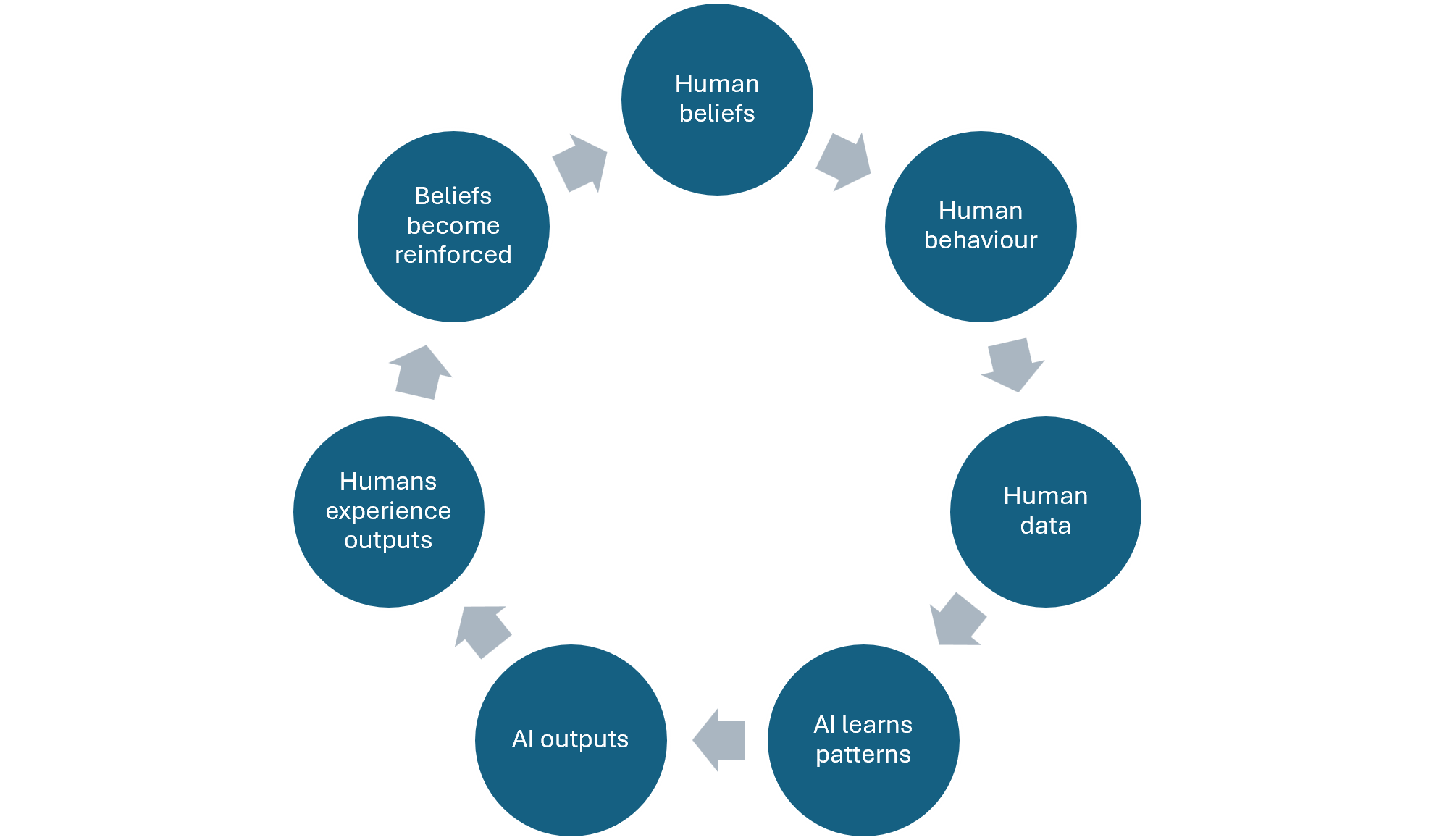
Here, psychology and technology begin to intersect in fascinating ways, which we can recognise in a cycle that has been repeating – and reinforcing itself – since the first iterations of artificial intelligence. It starts with human beliefs, which are enacted in human behaviour, producing human data. The ever-observant, pattern-recognising AI systems learn the patterns they see, and produce their outputs accordingly. Human beings then use the AI systems, experiencing their outputs. Without awareness, the beliefs become reinforced, and the cycle runs around again (see Figure).
Figure: Maintaining cycle whereby AI reinforces bias
If human beings naturally learn through prediction, and artificial intelligence learns from those same human patterns, then an important question emerges. Are we destined to remain trapped within this cycle of reinforcing assumptions, or is there something uniquely human that allows us to step outside it? Moreover, if both human beings and artificial intelligence rely upon pattern recognition, what distinguishes them? The answer is not intelligence. Nor is it memory. It is the uniquely human capacity for reflection. Let us see how we may help clients move toward that; it lies in the habit of being curious.
From prediction to curiosity
The three clients described in the opening vignette were each responding to different AI systems. Yet their experiences pointed toward a common psychological process that long predates artificial intelligence. Human beings are extraordinary pattern detectors.
Why pattern recognition makes evolutionary sense
From an evolutionary perspective, this makes perfect sense. Human beings evolved in environments where recognising patterns quickly could mean the difference between safety and danger. Long before the reflective capacities of the prefrontal cortex have an opportunity to evaluate a situation consciously, subcortical brain systems are already scanning for potential threat, familiarity, and significance (LeDoux, 1996; Siegel, 2020). These rapid, largely automatic processes are not evidence of faulty thinking; they are adaptive survival mechanisms that have helped human beings navigate an uncertain world for thousands of years.
Every day we encounter vastly more information than we could ever analyse consciously. If we had to evaluate every person, every conversation, and every situation from first principles, we would quickly become overwhelmed. Instead, the brain develops mental shortcuts. It notices regularities, groups similar experiences together, and gradually constructs expectations that allow us to respond efficiently to an extraordinarily complex social world (Kahneman, 2011).
Most of the time, these predictive processes serve us remarkably well. They help us recognise familiar faces in crowded places, anticipate another person’s emotional state, interpret social cues, avoid genuine danger, and make thousands of everyday decisions without exhausting our limited attentional resources. Rather than representing flaws in human cognition, they are among the reasons our species functions as effectively as it does.
The risks of overgeneralisation
The challenge arises because the same psychological processes that allow us to detect meaningful patterns can also lead us to overgeneralise them.
Experiences involving a relatively small number of people may gradually become assumptions about much larger groups. Stories repeated within families, schools, workplaces, news media, and popular culture may slowly begin to feel less like stories and more like objective reality. Once these expectations become established, our brains naturally become more likely to notice information that confirms existing beliefs than information that challenges them – a phenomenon psychologists have long recognised as confirmation bias (Nickerson, 1998).
Overgeneralisation at societal level
Importantly, these processes are not simply individual. Every culture communicates powerful narratives about who belongs, who leads, who is trustworthy, whose achievements are celebrated, whose suffering is recognised, and whose voices are heard. Children absorb these messages long before they possess the cognitive maturity to evaluate them critically. Through countless everyday experiences, they gradually learn not only who they are, but also what society expects from other people (Bandura, 1977).
For therapists, recognising these processes is not an invitation to label ourselves or others as inherently prejudiced. Rather, it encourages humility. Every human being – including every therapist – relies upon mental shortcuts to navigate an immensely complicated world. The therapeutic goal is therefore not to eliminate these automatic processes, an impossible task, but to become increasingly aware of them so that curiosity can remain stronger than certainty.
The human capacity to become aware of predicting
The comparison is illuminating. Human beings predict. Artificial intelligence predicts. Yet there is one profound difference. Human beings possess the capacity to become aware that they are predicting. We can notice our assumptions, question our first impressions, seek additional information, and revise conclusions that no longer fit the evidence before us. Although these reflective processes require greater effort than our automatic responses, they allow us to move beyond initial expectations rather than becoming permanently constrained by them.
This capacity for reflection lies at the heart of psychotherapy. Clients rarely seek therapy because they experience automatic thoughts or rapid emotional reactions. Such responses are part of ordinary human functioning. More often, they seek therapy because particular patterns of thinking, feeling, or interpreting the world have become rigid, repetitive, or no longer serve them well.
Psychotherapy: Transforming prediction into curiosity
Whether working with anxiety, trauma, depression, relationship difficulties, or experiences of discrimination, therapists gently invite clients to pause, examine their assumptions, and consider alternative ways of understanding themselves and others. In many respects, psychotherapy is the practice of transforming prediction into curiosity.
This perspective offers an important way of understanding clients’ encounters with AI. The most clinically significant question is often not whether an algorithm has produced a biased output, but how that output has intersected with the client’s existing beliefs, experiences, and life story. An AI-generated image, recommendation, or assumption may resonate because it echoes messages the client has encountered repeatedly throughout their life. Echoes repeat what has already been spoken.
Conversely, therapy begins when someone asks a new question. Understanding this difference prepares us to consider how human assumptions, social narratives, and artificial intelligence can become woven together into a powerful cycle of reinforcement – and, importantly, where therapists can help interrupt that cycle.
Returning to the therapy room: Helping clients respond to AI bias
The psychologist from the opening vignette cannot change the datasets upon which artificial intelligence has been trained. She cannot rewrite centuries of social history, eliminate discrimination, or ensure that every future AI interaction will be fair.
What she can do is something equally important. She can help her clients understand what happened within them when those encounters occurred.
This distinction matters because the deepest wounds associated with bias rarely arise from a single interaction in isolation. More often, painful moments resonate because they connect with experiences accumulated over many years. An AI-generated image, an unexpected recommendation, or an apparently biased response may become emotionally powerful precisely because it echoes stories clients have encountered repeatedly throughout their lives (Siegel, 2020; McAdams & McLean, 2013).
Witnessing before explanation
The therapist’s first task is therefore not explanation. It is witnessing (Rogers, 1961; Siegel, 2020). When a client says, “Even the computer doesn’t expect someone like me to belong,” the temptation may be to reassure them by explaining how AI systems are trained or by emphasising that algorithms possess no conscious intentions. Although factually accurate, such explanations may inadvertently bypass the client’s emotional experience.
Instead, therapy begins somewhere much simpler.
- “What was that moment like for you?”
- “What happened inside you when you saw those images?”
- “What did you find yourself thinking about yourself?”
These questions acknowledge that psychological meaning is more important than technological accuracy. The issue is not simply what the algorithm produced, but what the client experienced.
Once clients feel understood, therapy can gently become more exploratory. Many therapists will recognise familiar questions emerging.
- “Did this remind you of other experiences?”
- “Have there been other times when you have felt invisible or overlooked?”
- “What story about yourself seemed to become stronger in that moment?”
Notice how the focus gradually shifts. The conversation is no longer primarily about artificial intelligence. It has become a conversation about the client’s life.
For some individuals, the AI interaction may reinforce long-standing experiences of racism, sexism, ageism, ableism, or other forms of discrimination. For others, it may connect with earlier experiences of exclusion, rejection, or not feeling seen. The technology has not created these stories. It has simply become another place where they appear to be repeated (Bandura, 1977; McAdams & McLean, 2013).
The distinction between repeated messages and enduring truths
This distinction opens an important therapeutic opportunity. One of psychotherapy’s enduring contributions is helping clients distinguish between repeated messages and enduring truths. Many people understandably begin to experience repeated societal messages as though they represent objective reality. Therapy gently invites another possibility: perhaps some of these messages are better understood as echoes rather than facts.
Echoes feel convincing because they are familiar. But familiarity is not the same as truth.
Helping clients make this distinction is not an exercise in positive thinking or denial. Rather, it involves developing sufficient psychological distance to examine inherited assumptions rather than automatically accepting them (Hayes et al., 2012). Clients begin asking questions that the echo itself cannot answer.
- “Whose voice does this remind me of?”
- “Through whose eyes am I being seen – or not seen – here?”
- “When did I first begin believing this?”
- “Does this conclusion genuinely fit my experience, or has it simply been repeated often enough to feel inevitable?”
These questions mark an important shift. The client is no longer merely reacting to the AI output. They are reflecting upon it (Beck, 1976). Perhaps most importantly, therapy gradually restores a sense of agency.
Conclusion: Whose eyes, whose voices?
Clients cannot control every algorithm they encounter (Hayes et al., 2012; Neff, 2023). They cannot ensure that every AI system will represent them fairly. Yet they can become increasingly intentional about the meanings they attach to these encounters. Rather than allowing each interaction to reinforce existing assumptions, clients can develop the capacity to pause, reflect, and decide whether the message deserves a place within their own understanding of themselves.
This is not only a therapeutic response to artificial intelligence. It is one of psychotherapy’s oldest and most enduring tasks. Throughout history, people have encountered voices that have told them who they are, where they belong, and what they should expect from the world. Throughout history, people have been seen – or worse, made invisible – through others’ unwelcome eyes. Sometimes those voices or those eclipsing, judging eyes have come from families. Sometimes from communities, institutions, or culture (Rogers, 1961; Winnicott, 1971).
Today, those voices and those eyes may occasionally come from artificial intelligence. The therapist’s role remains remarkably consistent. Not to silence every voice. Not to invalidate every eye. But to help clients discover which of others’ perceptions are truly worthy of being believed.
Key takeaways
- Artificial intelligence has not invented human bias. Rather, AI systems learn statistical patterns from human-generated data and may therefore reproduce long-standing social assumptions and inequalities.
- The human tendency to form rapid impressions and make predictions is an adaptive cognitive process that enables us to navigate an extraordinarily complex social world. Problems arise not because people recognise patterns, but because patterns can become overgeneralised and mistaken for enduring truths.
- AI bias is best understood not simply as a technological issue, but as a psychological and societal one. The outputs generated by AI often reflect broader cultural narratives that have developed over many years.
- For many clients, encounters with apparently biased AI systems are emotionally significant because they resonate with earlier experiences of exclusion, discrimination, invisibility, or not belonging. The AI interaction becomes another chapter in an existing life story rather than an isolated event.
- Therapists need not become experts in artificial intelligence to work effectively with these concerns. Their primary task remains understanding the client’s emotional experience and the personal meanings attached to it.
- Rather than debating whether an AI response is objectively fair or unfair, therapy often becomes most helpful when exploring how the client’s existing beliefs, relationships, identity, and life history have shaped the impact of that experience.
- Psychotherapy invites clients to move beyond automatic prediction towards reflective curiosity. By examining inherited assumptions rather than automatically accepting them, clients can begin distinguishing repeated societal messages from enduring personal truths.
- Although therapists cannot eliminate societal bias or redesign artificial intelligence, they can help clients develop greater awareness, psychological flexibility, and agency. In doing so, clients become increasingly able to decide which voices – and which echoes – deserve to influence the stories they tell about themselves and others.
Questions therapists often ask
Q. Should therapists discuss whether an AI system is objectively biased?
A. Clients are usually less interested in a technical analysis of AI than in understanding why an interaction affected them so deeply. While acknowledging that AI systems may reflect historical and societal biases, therapy is generally more productive when exploring the personal meaning of the experience and how it connects with the client’s broader life story.
Q. How can I respond without minimising experiences of discrimination?
A. Avoid rushing to reassure clients that “it’s only an algorithm” or explaining away their experience. Instead, begin by acknowledging the emotional impact of the encounter. Exploring what the interaction represented to the client often creates space for richer conversations about identity, belonging, fairness, and resilience.
Q. How do I avoid imposing my own views about social or political issues?
A. Therapists need not persuade clients to adopt a particular interpretation of AI or society. Instead, they can remain curious about how clients understand their experiences, while helping them distinguish between automatic assumptions, repeated societal messages, and personally chosen beliefs. Curiosity remains more therapeutically valuable than certainty.
Q. What if I become aware of my own assumptions during therapy?
A. This is an opportunity rather than a failure. Every therapist relies upon mental shortcuts and predictive thinking. Clinical practice involves developing sufficient self-awareness to notice these assumptions, reflect upon them, and remain open to being surprised by the person sitting in front of us. Supervision, reflective practice, and cultural humility all support this ongoing process.
Q. What is the central therapeutic task when working with clients affected by AI bias?
A. The goal is not to convince clients that bias no longer exists, nor to encourage them to ignore genuine experiences of discrimination. Rather, therapy helps clients develop the freedom to examine the messages they encounter, recognise which are echoes of broader social narratives, and decide – thoughtfully and compassionately – which voices deserve to shape their understanding of themselves and others.
References
- Ambady, N., & Rosenthal, R. (1993). Half a minute: Predicting teacher evaluations from thin slices of nonverbal behavior and physical attractiveness. Journal of Personality and Social Psychology, 64(3), 431–441. https://doi.org/10.1037/0022-3514.64.3.431
- Bandura, A. (1977). Social learning theory. Prentice Hall. ISBN 10: 0138167516 ISBN 13: 9780138167516
- Beck, A. T. (1976). Cognitive therapy and the emotional disorders. New York: International Universities Press.
- Dwivedi, Y.K., Kshetri, N., Hughes, L, Slade, E.L. et al., (2023). “So, what if ChatGPT wrote it?” Multidisciplinary perspectives on opportunities, challenges and implications of generative conversational AI for research, practice and policy. International Journal of Information Management, 71, 102642. https://doi.org/10.1016/j.ijinfomgt.2023.102642
- Hayes, S. C., Strosahl, K. D., & Wilson, K. G. (2012). Acceptance and commitment therapy: The process and practice of mindful change (2nd ed.). The Guilford Press.
- Kahneman, D. (2011). Thinking, fast and slow. Farrar, Straus and Giroux.
- LeDoux, J. (1996). The emotional brain: The mysterious underpinnings of emotional life. Simon & Schuster.
- McAdams, D. P., & McLean, K. C. (2013). Narrative identity. Current Directions in Psychological Science, 22(3), 233–238. https://doi.org/10.1177/0963721413475622
- Neff, K. D. (2011). Self-compassion: The proven power of being kind to yourself (Updated ed.). Hodder & Stoughton.
- Nickerson, R. S. (1998). Confirmation bias: A ubiquitous phenomenon in many guises. Review of General Psychology, 2(2), 175–220. https://doi.org/10.1037/1089-2680.2.2.175
- Rogers, C. (1961). On becoming a person: A therapist’s view of psychotherapy. Boston: Houghton Mifflin.
- Siegel, D. J. (2020). The developing mind (3rd ed.). Guilford Press.
- Sundar, S. S. (Ed.). (2015). The handbook of the psychology of communication technology. John Wiley and Sons, Inc. ISBN 1118426452, 9781118426456
- Winnicott, D. W. (1971). Playing and reality. Routledge.