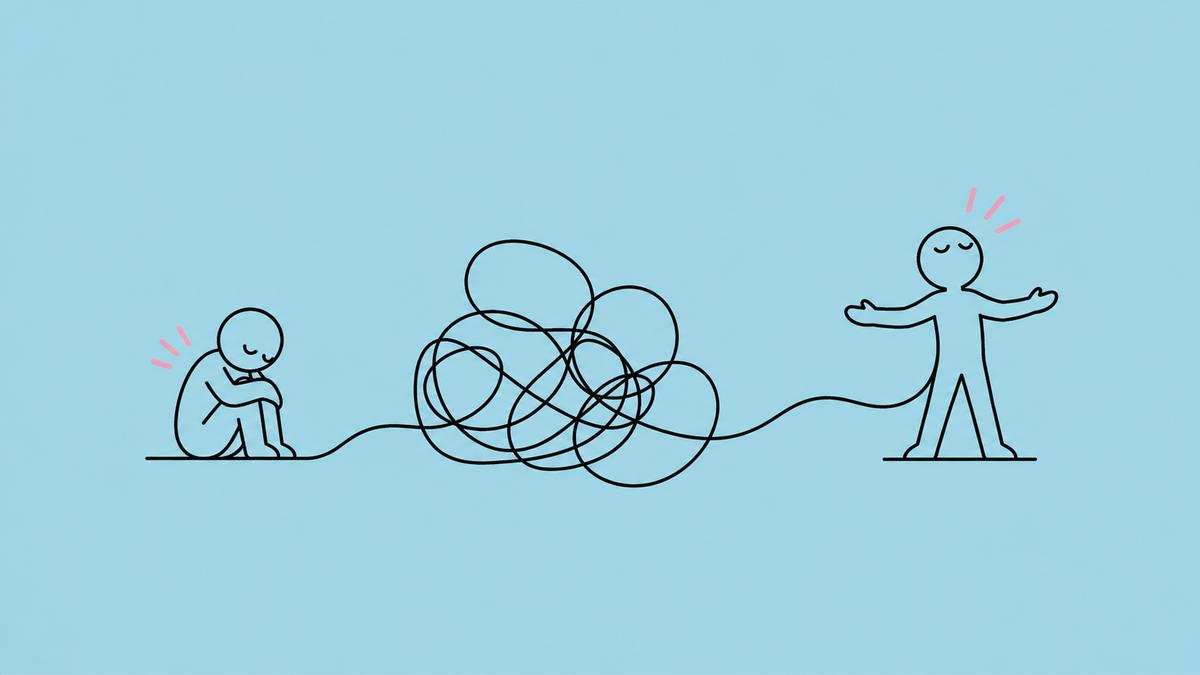


How therapists can notice movement, shifts, and embodied signals without turning the client’s body into a code to be cracked.
Related articles: Beyond Talk Therapy: Somatic Interventions for Trauma Treatment, Therapies for First Nations Australians: Expressive, Somatic, and Trauma-sensitive.
Jump to section
- Introduction: Therapists as observers not decoders
- The body joins the conversation
- Gestures as living symbols
- Notice change, not codes
- Whose body are we reading?
- When words and movement diverge
- The therapist’s body joins the conversation
- From observation to dialogue
- Conclusion: Listening with our eyes
- Key takeaways
- Questions therapists often ask
- References
Introduction: Therapists as observers not decoders
A client is describing a difficult conversation with her mother. Her account is thoughtful and measured. “It was fine,” she says. “I knew she would react like that.” As she speaks, however, one hand briefly lifts from her lap, palm outward, then disappears beneath the other.
The therapist notices. What should happen next?
Perhaps nothing. The movement may be incidental. Perhaps the therapist should simply keep listening. Or perhaps something has appeared in the conversation that is worth becoming curious about: not proof that the client is less “fine” than she says, and certainly not evidence that her body has betrayed some hidden truth, but another small piece of communication occurring alongside her words.
Psychotherapists work in a curiously rich communicative environment. We listen to what clients say, but we also encounter pauses, changes in rhythm, alterations in voice, movements towards and away from us, hands that become animated or suddenly still, bodies that expand while describing one experience and seem to contract while approaching another. Much of this information is registered almost automatically. Experienced therapists may sense that “something changed” before they can say exactly what they noticed.
Yet what are we entitled to make of such observations? Popular accounts of body language have encouraged the appealing idea that movements can be decoded: folded arms signify defensiveness, looking away signals dishonesty or avoidance, touching the face reveals anxiety. Contemporary research gives us much less support for such certainty. What it offers instead is both more modest and, for psychotherapy, potentially more useful. Gesture is deeply intertwined with language, thought, and communication, and it can sometimes carry information that speech does not express in quite the same way (Kita & Emmorey, 2023). But gestures do not come with universally reliable psychological translations.
For therapists, then, the challenge is not to become better decoders of the body. It is to become better observers of embodied communication while remaining appropriately uncertain about what an observation means.
That requires three related capacities: learning to see, learning not to know too quickly, and learning how to respond.
The body joins the conversation
Gesture is sometimes treated as the nonverbal accompaniment to the “real” message conveyed through words. Research in gesture and cognition challenges that distinction. Gesture and language operate together in human communication. People use movements of the hands, face, and body not simply to embellish what they are saying but as part of the process through which meaning is expressed and, in some circumstances, thought itself is organised. Gesture can represent actions, relationships, directions, and spatial arrangements; it can emphasise or elaborate spoken meaning; and it can convey information that is not explicitly contained in accompanying speech (Kita & Emmorey, 2023).
This matters in psychotherapy because therapy is often described as a “talking” treatment. Of course it is. But talking is an embodied activity. Consider the client trying to explain the distance that has developed between herself and her partner. She may say, “We just aren’t as close anymore,” while slowly moving her hands apart. Another client describing pressure at work may hold his hands close together as though compressing an invisible object. Someone struggling to describe conflicting loyalties may alternate her hands between two positions in space before she has found language for the dilemma.
These movements need not conceal anything mysterious. Indeed, their significance may be quite straightforward. Gesture can give visible form to an idea that speech is simultaneously trying to express. More intriguing are occasions when gesture contributes something that the words do not.
Research extending across decades has demonstrated that information conveyed through gesture does not always correspond exactly with information conveyed in speech. This phenomenon, often studied as gesture–speech mismatch, has been particularly well established in research on learning and cognitive development. In those contexts, gesture can reveal information not expressed verbally and, under some conditions, mismatch between gesture and speech is associated with a person’s readiness for conceptual change (Goldin-Meadow, 2025).
That finding should not be transported wholesale from cognitive-development research into psychotherapy. A client whose hands appear to “disagree” with her words cannot therefore be assumed to be concealing an emotion, approaching insight, or becoming ready for therapeutic change. But the research establishes something more fundamental that is clinically relevant: speech does not necessarily exhaust what a person is communicating. Sometimes the hands add another line to the conversation.
Gestures as living symbols
It is tempting at this point to make too much of that additional line. If gesture can convey meaning that speech does not, perhaps the therapist simply needs to learn what particular gestures signify. The problem is that this returns us to the very decoding model the evidence asks us to distrust.
A more useful therapeutic stance may be to approach some gestures as living symbols. By this, we do not mean that every movement possesses a hidden psychological meaning, or that the therapist can infer unconscious material from the angle of a client’s shoulders or the position of their hands. Rather, a living symbol is an embodied expression occurring in a particular moment of thought, feeling, and relationship. Its possible meaning lies not in a universal dictionary but in the person who makes it, the context in which it appears, and what happens around it.
A client, for example, may repeatedly make a small closing movement with both hands while talking about the weeks following her father’s death. A therapist observing this could privately generate many hypotheses. Perhaps the movement expresses containment. Perhaps it reflects a wish to hold onto something. Perhaps she is bracing herself. Perhaps she is regulating rising emotion.
Or perhaps her hands are cold.
The clinically important distinction is between having hypotheses and believing them. If the gesture becomes sufficiently salient to the therapeutic process, the therapist might eventually say: “I’ve noticed that your hands make this small movement when we come close to talking about those weeks. I wonder whether you’ve noticed it too?”
The client may look down, repeat the movement and say, “It’s like I’m trying to keep everything inside.”
Now the gesture has acquired meaning – but notice where the meaning came from. Not from the therapist’s body-language expertise. From the client’s experience.
Another client making precisely the same movement might say, “Oh, that’s just something I do when I’m concentrating.” Another might discover no meaning at all. Another may become curious only after several sessions. The therapist’s task is not to impose symbolic significance where none exists but to create the conditions in which embodied experience can become available for reflection when doing so is useful.
Seen this way, gestures are “living” precisely because their meanings are not fixed. They unfold in context.
Notice change, not codes
This suggests a practical shift in what therapists look for. Instead of asking: What does this gesture mean? we can begin with: What just changed?
Perhaps a client who has gestured expansively throughout the session becomes abruptly still when a sibling is mentioned. Perhaps someone who has maintained an upright posture slowly folds inward while describing an apparently minor workplace interaction. Perhaps a client’s hands become increasingly active as anger enters an account that had previously sounded emotionally detached. Or perhaps a repetitive movement appears, disappears when the conversation changes, and returns when a particular subject is approached again.
None of these changes tells the therapist what is happening. They do, however, provide information about when something happened. That distinction may be enormously useful.
Rather than treating the body as a diagnostic instrument, the therapist can use observed change as a marker that helps locate moments deserving closer attention. What was being discussed when the movement altered? Did the client’s voice, speech rate, gaze, or affect change at approximately the same time? Is this movement unusual for this client or characteristic of them? Does it recur around particular material? What happens relationally immediately before and after it?
The unit of interest becomes not the isolated gesture but the sequence. This protects us from conclusions such as “crossed arms mean defensiveness” while allowing a more clinically meaningful observation: When we moved from discussing what happened to discussing how it affected you, I noticed that your arms folded tightly across your body and your voice became much quieter.
That is an observation. “You became defensive” is an interpretation. The distinction matters because interpretation can close inquiry precisely where observation might open it. It also encourages therapists to learn an underappreciated clinical skill: establishing a sense of the individual client’s ordinary repertoire. A person who moves constantly does not necessarily become clinically more significant because they continue moving. For that client, sudden stillness might attract attention. For someone naturally quiet and physically contained, an unexpected expansive gesture may be more noteworthy. The question therefore becomes less What do bodies do when people are distressed? and more What is this particular person’s body doing differently now?
Whose body are we reading?
Even this more cautious approach requires another safeguard: there is no culturally or neurodevelopmentally neutral way of gesturing.
Gesture varies across cultures in form, meaning, and conversational use. Cultural and linguistic communities differ not only in conventional gestures but also in how space, direction, politeness, and interaction are expressed through movement (Kita, 2009). A therapist who regards their own communicative norms as the baseline against which a client’s movements are interpreted therefore risks converting difference into psychological meaning.
Neurodiversity makes the same point from another direction. A recent systematic review and meta-analysis found differences between autistic and neurotypical participants in the frequency of some forms of gesture, but also considerable variability according to factors including age, task structure, observer familiarity, and the way gesture was measured (McKern et al., 2023). Such findings caution against assuming that there is a single “normal” amount or style of gesturing against which an individual client should be assessed.
The implications reach beyond autism. Movement may serve sensory or regulatory functions; disability or chronic pain may shape posture and movement; medication, fatigue, and physical comfort can alter expressivity; cultural learning can influence interpersonal distance, eye contact, and gestural style. A therapist who sees a client avert their gaze, move repetitively, or sit unusually still may be observing something important – but “important” does not necessarily mean psychologically defensive or symptomatic. This is one reason that curiosity is safer than certainty.
It also changes the status of clinical expertise. Expertise is not demonstrated by being able to look at a client’s body and know what is happening inside them. It may be demonstrated instead by the capacity to notice more while assuming less. That is especially important when words and movement appear to diverge. Those moments can be among the most intriguing in psychotherapy – and among the easiest to mishandle.
A client says, “I don’t care whether he comes back,” while one hand reaches briefly towards the empty chair beside her. What does the gesture mean? We do not know. But perhaps, for now, we do not need to. We have noticed that something happened. And that is where clinical inquiry can begin.
When words and movement diverge
Sometimes what attracts the therapist’s attention is not a gesture itself but an apparent discrepancy between different channels of communication. A client smiles while describing something painful. Another says, “It doesn’t matter,” while gripping the chair. Someone recounting a frightening experience remains verbally fluent but gradually becomes almost motionless.
Such moments can tempt therapists towards a hierarchy of truth: the words say one thing, but the body reveals what is really happening. Gesture research gives us reason to resist that conclusion. Gesture and speech can carry different or supplementary information, but difference does not tell us which channel is more truthful or what the discrepancy means (Kita & Emmorey, 2023).
This becomes especially important when therapists wonder about affective shifts, defensive processes, or dissociation. Trauma-related dissociation has been associated with changes in autonomic and defensive responding, including patterns involving motor inhibition and immobility (Beutler et al., 2022). But sudden stillness in a therapy room is not a diagnostic sign of dissociation. It may accompany fear, concentration, emotional absorption, fatigue, withdrawal, or something entirely particular to that client. Similarly, repetitive movement might accompany anxiety – or sensory regulation, physical discomfort, habit, or nothing requiring therapeutic attention.
The clinically useful information therefore lies less in the isolated behaviour than in its sequence, context, and accompanying changes. Did movement alter as particular material emerged? Did voice, gaze, responsiveness, or affect change too? Does the pattern recur? And, importantly, what does the client experience? The body can alert us that something may have changed without telling us what changed – or why.
The therapist’s body joins the conversation
Until now, we have been watching the client’s body. But there are two bodies in the room. Therapists gesture, shift position, change facial expression, alter vocal rhythm, and move towards and away from clients, too. Moreover, therapist and client can spontaneously coordinate aspects of movement, vocal behaviour, and physiology. This phenomenon, broadly described as interpersonal or nonverbal synchrony, has generated considerable psychotherapy research.
Its meaning, however, is not straightforward. Recent meta-analytic evidence does not support a simple equation in which greater synchrony necessarily produces better therapeutic alliance or outcome. Associations vary across studies, measures, and modalities, suggesting that the timing and context of coordination may matter more than the amount of synchrony itself (Gregorini et al., 2025; Jennissen et al., 2025).
This cautions against deliberately mimicking clients in the hope of manufacturing rapport. More useful may be awareness of the therapist’s own embodied participation in the encounter. A therapist might notice that she has begun leaning forward, holding her breath, becoming unusually still or speaking more rapidly. She might feel an impulse to move closer just as the client retreats, or discover that both have gradually slowed as difficult emotion settles into the room.
These responses do not provide privileged access to the client’s internal state. The therapist who notices herself pulling back cannot conclude, “My client is being threatening,” any more than she can diagnose the client by observing his crossed arms. Her own body, too, generates hypotheses rather than verdicts. But it may provide relational information worth holding in awareness.
The question thus broadens from “What is the client’s body doing?” to “What is happening between us – and how am I participating in it?”
From observation to dialogue
If gestures cannot simply be decoded, what should therapists actually do with what they notice? A useful process can be summarised as:
Notice → Pause → Contextualise → Decide whether it matters → Describe rather than interpret → Invite the client’s meaning → Follow what happens next.
Notice what changed, including its timing. Pause long enough to prevent observation becoming instant interpretation. Contextualise the movement within this client’s usual way of communicating, the material being discussed, culture, neurotype and other possible explanations. Then decide whether it matters. Many gestures require no intervention at all. Continually commenting on a client’s movements could create self-consciousness, interrupt spontaneous regulation, or make therapy feel more like surveillance than encounter.
When exploration does seem potentially useful, describe rather than interpret. Compare “You’re pushing your mother away” with “I noticed your hands moved outward just then as you mentioned your mother.” The first supplies meaning. The second makes an observation available for consideration. Then invite the client’s meaning: “Did you notice that?” “Does that movement seem connected to anything?” Or, where appropriate, “Would you like to make that movement again and see what you notice?” Finally, follow what happens next rather than forcing the observation to become significant.
Consider a client, Mara, discussing her mother’s death. Several times, as she describes the final weeks of her mother’s life, her hands move slowly outward. Her therapist notices the recurrence and privately wonders whether Mara is expressing anger or pushing away painful memories. She says nothing initially. Later, as Mara approaches the same material, the movement becomes larger.
“I’ve noticed your hands doing something when we talk about those last weeks,” the therapist says. “Would it be okay to pause there?”
Mara looks down. “Doing what?”
The therapist demonstrates the direction lightly without assigning meaning. Mara repeats the movement herself and remains quiet for several seconds.
“It’s strange,” she eventually says. “I’m not pushing her away. It’s like I’m trying to make room around her. Everyone kept crowding her at the end. I wanted her to have some space.”
The therapist’s original hypothesis was wrong. Her observation was still useful.
That distinction captures perhaps the central clinical skill involved in working with gesture. Therapists do not need to become expert readers of bodies. They need to become attentive enough to notice embodied communication, restrained enough not to colonise it with premature meaning, and curious enough to help clients explore it when exploration may deepen the work. A gesture may sometimes become a living symbol – not because the therapist discovers the secret it contains, but because therapist and client create enough space for its meaning, if it has one, to emerge.
Conclusion: Listening with our eyes
Perhaps the most useful thing therapists can learn about gesture is not how to interpret it, but how to remain curious in its presence. The body participates continuously in psychotherapy, sometimes reinforcing what words communicate, sometimes adding something different, and sometimes simply moving because human beings move. Clinical skill lies in learning to notice these embodied moments without demanding that they disclose a meaning.
When a gesture does seem to invite exploration, the therapist can offer it back gently: not as evidence, diagnosis, or revelation, but as something noticed together. We do not need to read bodies. We need to become better at listening with our eyes – and humble enough to let clients tell us what we have seen.
Key takeaways
- Gesture is part of communication, not merely an accompaniment to speech. It can contribute information, represent aspects of thought, and sometimes communicate something not explicitly contained in accompanying words.
- Gestures are not psychological codes. Individual movements do not reliably translate into particular emotions, defences, or internal states. Crossed arms do not necessarily mean defensiveness; looking away does not necessarily mean avoidance; stillness does not necessarily mean dissociation.
- Notice change before seeking meaning. Changes from a client’s usual patterns, particularly when they coincide with changes in affect, voice, attention, or conversational content, may be more clinically informative than isolated gestures.
- Context matters. Culture, neurotype, disability, sensory regulation, physical comfort, habit, and individual communication style can all shape movement. Difference should not automatically be psychologised.
- The therapist has a body too. Changes in our own posture, movement, breathing, or interpersonal distance can sometimes provide useful relational information, but these responses also require curiosity rather than certainty.
- Observation should precede interpretation. When a gesture seems worth exploring, describing what happened and inviting the client’s meaning usually preserves more therapeutic possibility than explaining the gesture to them.
- Sometimes the most skilful intervention is no intervention. Therapists can notice embodied communication without commenting on it. The question is not simply whether a gesture is interesting, but whether drawing attention to it is likely to serve the therapeutic process.
Questions therapists often ask
Q. Should I point out a gesture whenever I notice one?
A. Usually not. Therapists notice far more than they need to verbalise. Before commenting, consider whether the movement represents a meaningful change, whether it appears connected to the material being discussed, and whether drawing attention to it is likely to deepen rather than interrupt the work. Observation can remain useful even when it stays in the therapist’s awareness.
Q. What if a client’s words and body seem to be saying different things?
A. Treat the discrepancy as information rather than proof that one channel is more truthful than another. Gesture and speech can communicate different or supplementary information, but the body does not automatically reveal the “real” story. You might describe what you observed and invite exploration: “I noticed your hands became very still as you said that. Did you notice anything happening for you just then?”
Q. Can sudden stillness or other movement changes tell me that a client is dissociating?
A. Not by themselves. Changes in movement can accompany altered affective or defensive states, including dissociative phenomena, but they can also reflect concentration, fatigue, anxiety, sensory regulation, physical discomfort, or many other experiences. Look for patterns across multiple channels – such as changes in responsiveness, attention, voice, and affect – and check the client’s present-moment experience rather than diagnosing from movement alone.
Q. Should therapists deliberately mirror clients to strengthen rapport?
A. Current evidence on nonverbal synchrony does not support a simple “more synchrony is better” conclusion. Therapist and client may spontaneously coordinate aspects of movement, voice, or physiology, but associations with alliance and outcome are complex and inconsistent. Deliberately copying posture or gesture risks replacing genuine responsiveness with technique. Attuned presence is a safer aim than manufactured synchrony.
Q. How can I become more skilful at working with gesture?
A. Begin by practising observation without interpretation. Notice changes in movement, their timing, what was being discussed, what else changed simultaneously, and how the movement compares with that client’s usual style. Then use the sequence:
Notice → Pause → Contextualise → Decide whether it matters → Describe rather than interpret → Invite the client’s meaning → Follow what happens next.
The aim is not to become increasingly certain about what bodies mean. It is to become increasingly sensitive to embodied communication while remaining willing to discover that your first hypothesis was wrong.
References
- Beutler, S., Mertens, Y. L., Ladner, L., Schellong, J., Croy, I., & Daniels, J. K. (2022). Trauma-related dissociation and the autonomic nervous system: A systematic literature review of psychophysiological correlates of dissociative experiencing in PTSD patients. European Journal of Psychotraumatology, 13(2), 2132599. https://doi.org/10.1080/20008066.2022.2132599
- Goldin-Meadow, S. (2025). The mind hidden in our hands. Topics in Cognitive Science, 17(3), 443–468. https://doi.org/10.1111/tops.12756
- Gregorini, C., De Carli, P., Parolin, L. A. L., Tschacher, W., & Preti, E. (2025). Potential role of nonverbal synchrony in psychotherapy: A meta-analysis. Counselling and Psychotherapy Research, 25(1), e12885. https://doi.org/10.1002/capr.12885
- Jennissen, S., Huber, J., Ditzen, B., & Dinger, U. (2025). Association between nonverbal synchrony, alliance, and outcome in psychotherapy: Systematic review and meta-analysis. Psychotherapy Research, 35(7), 1213–1228. https://doi.org/10.1080/10503307.2024.2423662
- Kita, S. (2009). Cross-cultural variation of speech-accompanying gesture: A review. Language and Cognitive Processes, 24(2), 145–167. https://doi.org/10.1080/01690960802586188
- Kita, S., & Emmorey, K. (2023). Gesture links language and cognition for spoken and signed languages. Nature Reviews Psychology, 2(7), 407–420. https://doi.org/10.1038/s44159-023-00186-9
- McKern, N., Dargue, N., & Sweller, N. (2023). Comparing gesture frequency between autistic and neurotypical individuals: A systematic review and meta-analysis. Psychological Bulletin, 149(11–12), 724–745. https://doi.org/10.1037/bul0000408